
In the brandable vs keyword domain debate, brandable domains consistently outperform keyword domains on long-term brand equity, trademark defensibility, and scalability – while keyword domains (also called exact-match domains, or EMDs) offer narrow, diminishing SEO advantages that Google’s 2012 EMD update and subsequent algorithm refinements have steadily eroded. For most modern businesses, a well-chosen brandable domain delivers superior ROI across organic search authority, direct navigation traffic, and omnichannel marketing cohesion than any keyword-stuffed URL strategy can sustain.
Choosing the wrong domain name is one of the costliest branding mistakes a business can make. Your domain is not just a web address – it is the cornerstone of your digital identity, influencing everything from click-through rates and user trust to long-term SEO authority and trademark protection.
If you are building a business that needs to compete online, scale across markets, and earn genuine customer loyalty, then you need to understand exactly what separates a brandable domain from a keyword domain – and which one actually gives you the edge.
If you are ready to explore premium brandable domain options crafted for serious businesses, Aotiv’s curated domain marketplace offers a hand-selected portfolio of high-potential brandable names to accelerate your brand’s digital foundation.
What is a Brandable Domain?
A brandable domain is a domain name engineered to function as a distinctive brand identity rather than describe what a business does. These names are typically invented, coined, or creatively assembled – prioritizing memorability, phonetic appeal, and trademark uniqueness above literal description.
Examples of iconic brandable domains:
- Google.com – invented word, meaningless before the brand
- Spotify.com – combination of “spot” and “identify”
- Shopify.com – evokes commerce without describing products
- Stripe.com – clean, minimal, ownable
- Canva.com – abstract, short, globally recognizable
As explained in our complete guide to brandable domains, the power of a brandable name lies in its ability to become synonymous with the category it operates in – rather than merely describing it.
Key characteristics of a brandable domain:
- Short (typically 4-10 characters)
- Easy to spell and pronounce
- Unique and trademark-eligible
- No inherent meaning that limits business scope
- Strong emotional recall and aesthetic appeal
What is a Keyword Domain?
A keyword domain – also called an exact-match domain (EMD) or descriptive domain – is a web address that incorporates one or more of the primary search keywords related to a business’s products or services.
Examples of keyword domains:
- BestRunningShoes.com
- CheapFlightsUS.com
- NewYorkPlumbingServices.com
- OnlineLoanCalculator.net
The original appeal of keyword domains was straightforward: if someone searched “cheap flights US,” a domain like CheapFlightsUS.com would supposedly rank higher simply because the query matched the domain name. For a period in early SEO history, this shortcut worked reliably.
That era is largely over.
Brandable vs Keyword Domain: Core Differences at a Glance
| FACTOR | BRANDABLE DOMAIN | KEYWORD DOMAIN |
|---|---|---|
| Memorability | High – unique and sticky | Low – generic and forgettable |
| Trademark eligibility | Strong – usually registerable | Weak – descriptive terms rarely qualify |
| SEO signal (2026) | Authority-driven, long-term | Minimal keyword boost, content-dependent |
| Scalability | Unlimited – not category-locked | Limited – locked to original niche |
| Marketing versatility | Excellent across all channels | Restricted by literal description |
| Domain availability | Moderate – requires creativity | Low – most EMDs already registered |
| Direct navigation traffic | High over time | Low – users forget generic names |
| Business valuation impact | Positive – brand asset | Neutral to negative |
| Rebranding flexibility | High | Very low |
| User trust and perception | Professional, modern | Can appear dated or spammy |
SEO Performance: What the Data Actually Shows
This is where most businesses get confused – and where the brandable vs keyword domain debate gets most heated.
The Rise and Fall of Exact-Match Domain (EMD) SEO
For years, owning CheapInsurance.com or BestCreditCards.com was treated as an SEO shortcut. Keyword domains ranked well because early Google algorithms weighted domain name relevance heavily as a ranking signal.
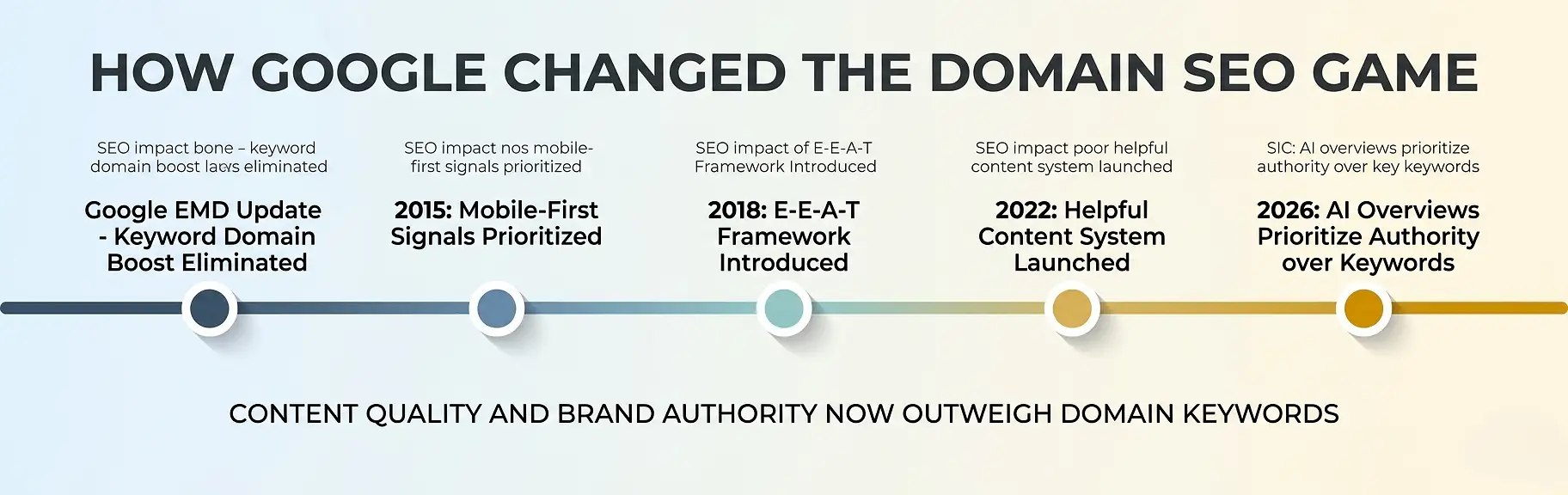
That changed in September 2012. Google’s URL structure and quality guidelines were reinforced through the EMD update, which targeted websites ranking purely on the basis of their domain keywords while offering thin, low-quality content. The ripple effects reshaped domain strategy permanently.
Since 2012, Google has continued deprioritizing domain keyword signals in favor of:
- Content quality and topical authority
- E-E-A-T (Experience, Expertise, Authoritativeness, Trustworthiness)
- Backlink profile and domain authority
- User engagement signals (dwell time, CTR, bounce rate)
- Core Web Vitals and technical performance
What this means in practice:
A keyword domain provides, at most, a minor contextual signal to search engines. That signal is easily negated by poor content quality or a weak backlink profile. Meanwhile, a brandable domain that builds genuine topical authority, earns high-quality backlinks, and delivers excellent user experience will consistently outrank keyword domains in competitive SERPs.
The Compound Authority Advantage of Brandable Domains
Brandable domains accumulate authority differently – and more durably. Consider how Google and AI search systems operate in 2026: they increasingly surface trusted, authoritative sources. Trust is built through:
- Consistent brand presence across the web
- Earned media mentions and editorial backlinks
- Strong social signals and branded search volume
- User behavior patterns such as direct navigation, low bounce rate, and high engagement
None of these signals are enhanced by a keyword in your domain. They are all enhanced by building a recognizable brand – and a brandable domain is the structural foundation of that brand.
According to analysis by SEO Hermit, domain strategy in 2026 should prioritize brand memorability and authority accumulation over keyword inclusion, particularly as AI-driven search systems increasingly favor trusted, consistent brand presences over literal keyword signals.
Brand Equity and Long-Term Business Value
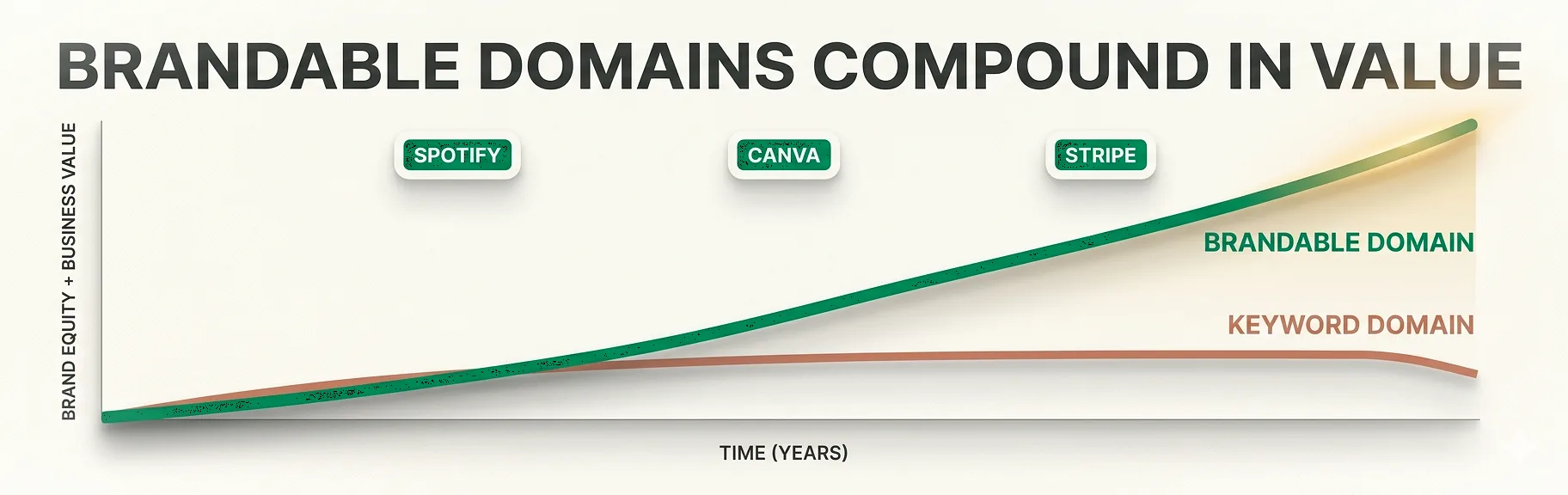
One of the most underappreciated dimensions of the brandable vs keyword domain comparison is brand equity – the tangible and intangible financial value a brand name generates over time.
Why Keyword Domains Erode Value
A keyword domain describes a function, not a brand. Consider what happens as your business evolves:
- You expand into new product categories
- You enter international markets
- You pivot your business model
- You seek venture capital or acquisition
In each scenario, a keyword domain works against you. A domain like “NewYorkPlumbing.com” signals a purely local, trade-specific operation – even if the business has grown into a national home services platform. Investors and acquirers typically discount businesses with generic, non-ownable domain names because they cannot be leveraged as brand assets.
Why Brandable Domains Compound in Value
A brandable domain, by contrast, is a genuine digital asset. Well-chosen brandable names:
- Appreciate in market value as the brand grows
- Command premium acquisition prices in M&A scenarios
- Create defensible brand moats that competitors cannot replicate
- Enable premium pricing psychology – a branded company commands higher perceived value than a generic one
Think about the difference in perception between “BestHotels.com” and “Airbnb.com.” Both operate in accommodation. Only one of them became a global category-defining brand worth tens of billions.
Trademark Protection and Legal Defensibility
This is a critical and often overlooked advantage in the brandable vs keyword domain conversation.
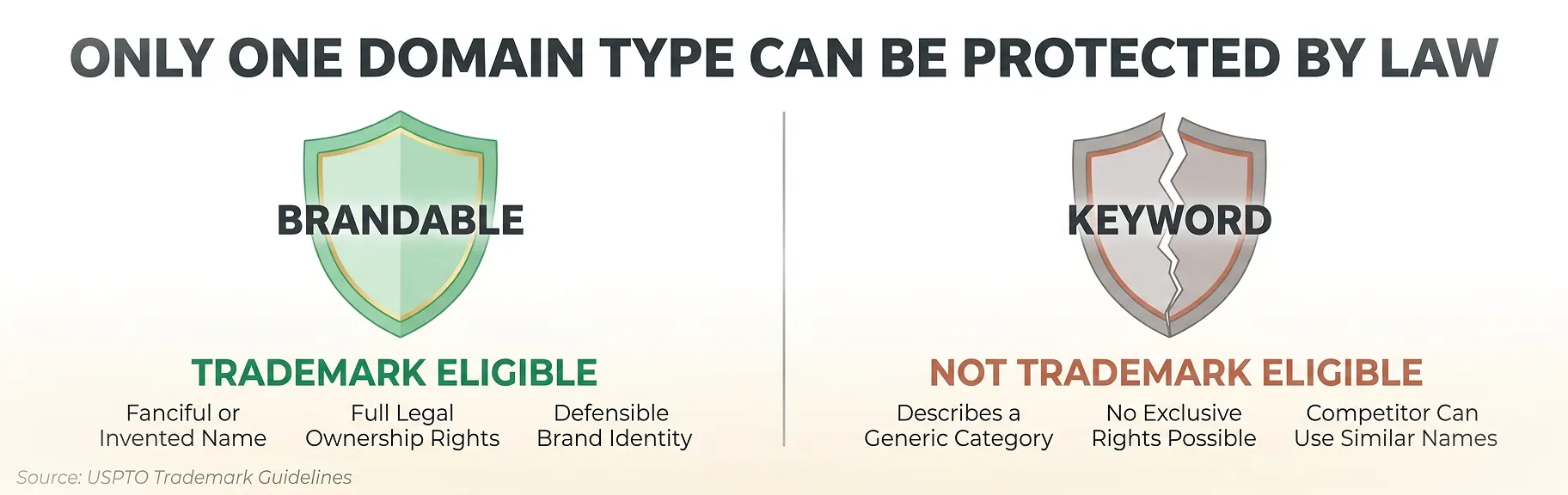
Keyword domains cannot be trademarked. Descriptive and generic terms – precisely the kinds of words found in keyword domains – are not eligible for trademark registration under USPTO and most international intellectual property frameworks. No single business should own exclusive rights to words that describe an entire category.
Brandable domains, on the other hand, are typically trademark-eligible from day one. A coined, invented, or creatively assembled name can be registered as a trademark, giving your business:
- Legal protection against domain squatters and copycats
- Exclusive rights to the name in your industry category
- The ability to enforce brand integrity across platforms
- Significantly higher asset value in financing and M&A transactions
According to USPTO trademark guidelines, fanciful and arbitrary marks – the categories that most brandable domain names fall into – receive the strongest level of trademark protection available, making them the most legally defensible choice for any business building long-term market position.
User Psychology and Click-Through Rates
Search engine rankings tell only part of the story. Even if two domains rank equally in search results, user behavior is heavily influenced by the domain name itself.
The Trust Signals of a Brandable Domain
Research into user behavior and click-through rate (CTR) optimization consistently shows that:
- Users trust short, clean, memorable domain names more than keyword-stuffed URLs
- Brandable names signal professionalism, investment, and permanence
- Generic keyword domains are frequently associated with spam, low-quality affiliate sites, and outdated business models
- Consumer recall drops significantly when brand names exceed 12 characters – every syllable matters
Consider two competing results in a Google search for “project management software”:
- Result A: projectmanagementsoftwaretools.com
- Result B: asana.com
Even if Result A ranks one position higher, most users will click Result B. The brandable domain signals legitimacy, quality, and scale.
Direct Navigation and Branded Search: The Hidden SEO Moat
One of the strongest long-term SEO advantages of a brandable domain is its ability to generate branded search volume and direct navigation traffic. When users remember your name and type it directly into the browser, or search specifically for your brand, you receive:
- Zero-competition traffic that no competitor can intercept
- Strong positive user engagement signals that Google uses as ranking factors
- Reduced customer acquisition cost over time
- Higher conversion rates from brand-intent visits
A keyword domain can never fully build this moat. Generic names simply are not memorable enough for users to return to directly.
When a Keyword Domain Still Makes Sense
To provide a fully balanced analysis, it is important to acknowledge the specific scenarios where a keyword domain remains a viable or even strategic choice.
Keyword domains can still make sense when:
- You operate a highly local, single-service business where the geographic and service keyword domain directly aids local SEO (e.g., PhoenixRoofRepair.com for a roofing business serving only Phoenix)
- You are building a niche content site or affiliate portal focused on a single keyword cluster, where EMD signals provide a marginal ranking edge in low-competition verticals
- You are running a short-term lead generation campaign where brand building is not the objective
- You need a product-specific landing page URL for a campaign, separate from your main brand domain
However, even in these scenarios, the advantages are narrowing as Google continues refining its algorithms, and as AI-driven search shifts the landscape further toward authority and trust signals rather than literal keyword matching.
Common Mistakes Businesses Make When Choosing a Domain
Understanding the brandable vs keyword domain debate is only useful if it helps you avoid costly errors. Here are the most common domain choice mistakes:
1. Choosing a keyword domain to “hack” SEO rankings This strategy worked in 2009. In 2026, it signals a misunderstanding of modern search algorithms and often results in a domain that limits brand growth.
2. Selecting a domain that is too long Consumer recall drops significantly when domain names exceed 10-12 characters. Every additional character is a memory burden that costs you direct traffic.
3. Ignoring trademark availability before purchasing Many businesses buy a domain without checking whether the name – or a confusingly similar version of it – is already trademarked. This creates expensive legal exposure.
4. Choosing a keyword domain because “it was cheap” Domain registration cost is irrelevant compared to the marketing, brand, and legal costs of choosing the wrong name. A $9 keyword domain can cost tens of thousands to migrate away from later.
5. Not stress-testing the name for international markets Brandable names need to be phonetically neutral and free of negative connotations across key target languages and cultures before committing.
6. Treating the domain decision as reversible Domain migrations are among the most SEO-damaging technical events a website can undergo. Choose once, choose wisely.
7. Copying competitor naming conventions Mirroring competitors’ domain strategy creates confusion, legal risk, and a permanent positioning disadvantage in your market.
Expert Tips for Choosing the Right Domain Type
Whether you lean toward brandable or keyword, apply these expert-level principles to ensure your domain choice serves your long-term business strategy.
Tip 1: Prioritize brand-building over short-term SEO gains In the current search landscape, content quality and topical authority build rankings far more reliably than domain keywords. Invest in the name that builds your brand.
Tip 2: Conduct a TACO analysis before purchasing Evaluate every candidate domain across four dimensions: Trademark eligibility, Availability across social platforms, Character count and phonetics, and Offensive connotation checks across languages.
Tip 3: Choose a .com TLD unless your market strongly prefers an alternative For global businesses, .com remains the most trusted extension. Users default to .com when typing directly, meaning non-.com domains lose direct navigation traffic to their .com counterparts.
Tip 4: Test recall with non-technical users Say the domain name aloud to five people who are not in your industry. If fewer than four can correctly spell and repeat it back within 24 hours, keep searching.
Tip 5: Think in decades, not quarters The best brandable domains grow more valuable with every year of consistent brand investment. Choose a name you can commit to for the life of your business.
Tip 6: Check the domain’s history Use tools like the Wayback Machine and domain history checkers to verify the domain has not previously been used for spam, adult content, or other activities that may have created negative search engine associations.
How to Evaluate a Brandable Domain in 5 Steps
If you have decided that a brandable domain is right for your business, here is a structured evaluation framework:
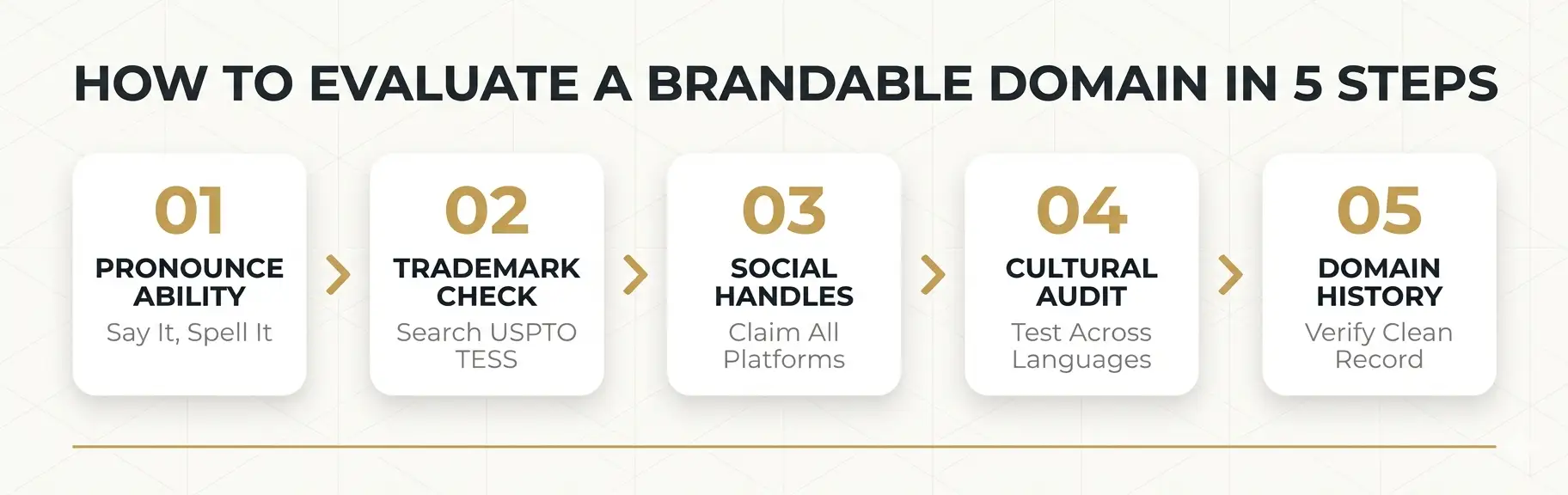
Step 1: Test pronounceability and spellability Read the domain aloud. If people struggle to spell it from hearing it, or struggle to pronounce it from reading it, eliminate it immediately.
Step 2: Check trademark availability Run searches on USPTO TESS and equivalent international databases to confirm no existing trademark conflicts exist in your industry category.
Step 3: Audit social media handle availability Consistent brand identity across web and social platforms is essential. Check that matching or closely similar handles are available on LinkedIn, Instagram, X, and other relevant platforms.
Step 4: Evaluate linguistic and cultural neutrality Run the name through basic translation checks in the top 3-5 languages of your target markets. Avoid names with unintended meanings or difficult phonetics in key regions.
Step 5: Assess domain history and trust signals Use domain history tools to check for prior spam, penalized content, or black-hat link profiles. A clean history ensures you inherit no algorithmic debt from previous owners.
Frequently Asked Questions: Brandable vs Keyword Domain
Q1: What is the main difference between a brandable vs keyword domain? A brandable domain is an invented, unique name designed to build brand identity – like Spotify or Canva. A keyword domain incorporates literal search terms, such as “BestRunningShoes.com.” Brandable domains build long-term brand equity and are trademark-eligible; keyword domains offer limited, diminishing SEO benefits and cannot typically be trademarked.
Q2: Do keyword domains still help with SEO rankings? Keyword domains provide a marginal contextual signal to search engines, but Google’s 2012 EMD update significantly reduced their impact. In 2026, content quality, topical authority, backlink profile, and E-E-A-T signals are far more important ranking factors than whether your domain contains target keywords.
Q3: Can I trademark a keyword domain? Generally, no. Descriptive and generic terms – the type commonly found in keyword domains – are not eligible for trademark registration under USPTO guidelines. Only distinctive, fanciful, or arbitrary names (the hallmarks of brandable domains) qualify for the strongest trademark protection.
Q4: Which is better for a startup: a brandable or keyword domain? For startups with ambitions to scale, raise funding, or build a recognizable brand, a brandable domain is almost always the better choice. It provides trademark protection, brand equity, and the flexibility to grow beyond a single product or market – none of which a keyword domain can deliver.
Q5: How do I find a good brandable domain? Look for names that are short (under 10 characters), easy to pronounce and spell, phonetically clean, trademark-eligible, and available on major social platforms. Always verify trademark availability before purchasing. You can explore vetted options directly at Aotiv.
Q6: Does the domain extension (.com vs .io vs .co) matter for SEO? Domain extensions are not a direct Google ranking factor. However, .com remains the most trusted extension for most users globally, generating higher direct navigation traffic and user confidence. For most businesses, .com is the strongest long-term choice.
Q7: Is it too late to switch from a keyword domain to a brandable domain? It is never too late, but domain migrations carry SEO risks if not executed correctly. The process requires careful 301 redirect strategy, consistent link building to the new domain, and sustained brand marketing investment. The earlier you make the switch, the lower the migration cost.
Q8: What is the biggest mistake in the brandable vs keyword domain decision? The most common mistake is treating domain choice as a reversible SEO tactic rather than a long-term brand investment. Choosing a keyword domain to “rank faster” typically results in a domain that limits growth, prevents trademark registration, and requires an expensive migration later.
Conclusion
The brandable vs keyword domain debate has a clear winner for most modern businesses: brandable wins.
Keyword domains were a legitimate SEO tactic in the early 2010s. Today, they offer a narrow, diminishing advantage at best – and a significant strategic liability at worst. They lock you into a single niche, prevent trademark registration, erode user trust, and create rebranding risks that grow more expensive every year.
Brandable domains, by contrast, are genuine long-term business assets. They build brand equity, earn trademark protection, generate direct navigation traffic, and scale with your business no matter how many times your strategy evolves. The world’s most valuable companies – Google, Shopify, Stripe, Canva, Spotify – all chose brandable names. That is not a coincidence.
If you are serious about building a business that compounds in value, start with the right digital foundation. A well-chosen brandable domain is not a cost – it is an investment with asymmetric upside.
Ready to find the perfect name for your next venture? Explore Aotiv’s premium brandable domain portfolio and secure a domain built for the brand you are building.