
How phonetics shape brand perception is not a matter of subjective taste – it is a measurable, neurologically grounded process in which phoneme selection, syllabic stress patterns, and articulatory dynamics directly encode cognitive signals of trust, speed, size, and authority into a brand name before any conscious evaluation occurs. Sound symbolism research, including the foundational Bouba/Kiki effect and decades of subsequent phonosemantic studies, demonstrates that consonant class (plosive vs. fricative), vowel frontness, and syllable rhythm systematically influence consumer preference, recall fidelity, and perceived brand positioning across languages and cultures. For founders, brand strategists, and domain buyers, this means the phonetic architecture of a name is not cosmetic – it is a structural business asset.
Every great brand name passes a test its creator may never have consciously designed it for. It sounds right. It lands with authority, or warmth, or velocity – depending on what the brand needs to communicate. That is not coincidence. It is applied linguistics, and understanding it will fundamentally change how you approach the most important naming decision your business will ever make.
Building a brand that resonates starts long before the logo or the tagline. It starts with the sound of the name itself. If you are in the process of choosing a domain for a new venture or rebrand, Aotiv’s curated portfolio of phonetically engineered brandable domains gives you a structured starting point for names built to resonate.
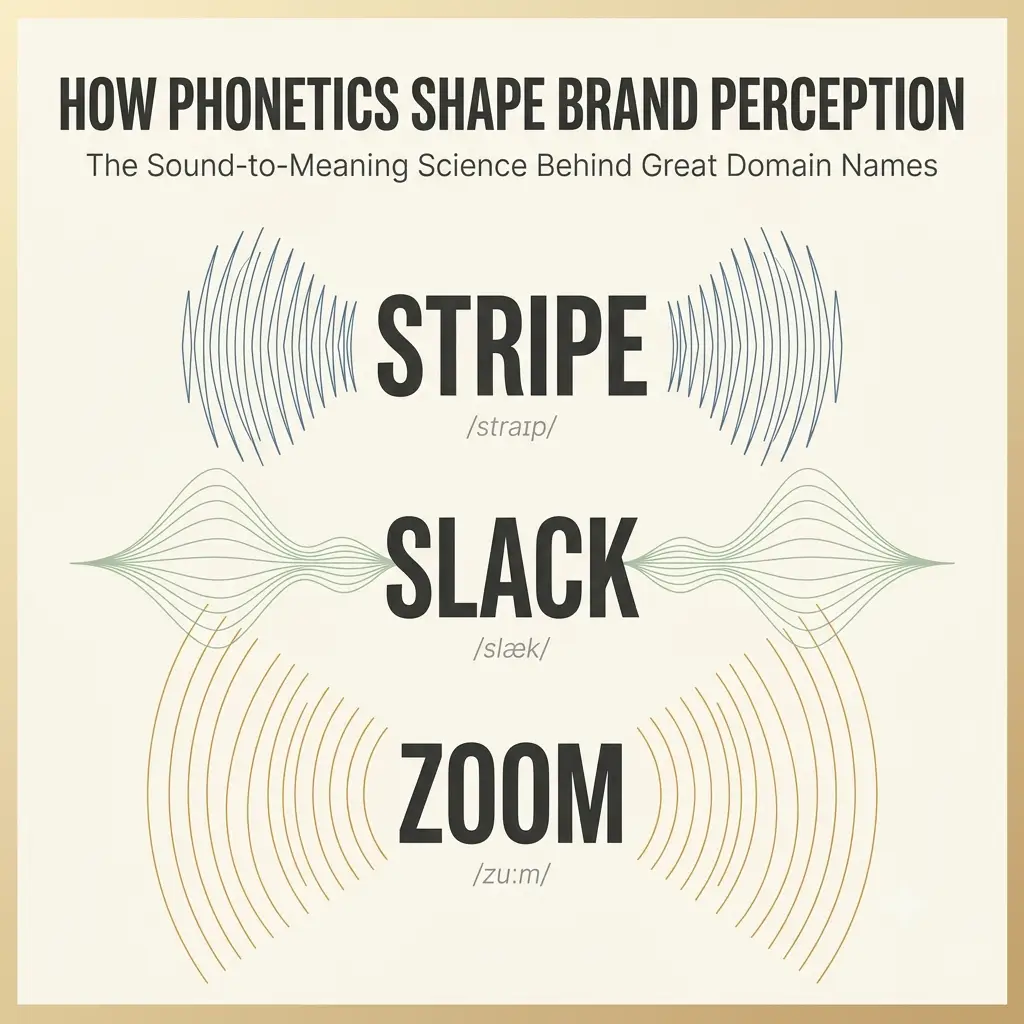
What is Phonetic Brand Perception?
Phonetic brand perception refers to the way the sounds within a brand name – its consonants, vowels, rhythm, and stress – unconsciously communicate meaning, emotional tone, and brand attributes to the listener or reader.
Most people assume naming is primarily a semantic exercise: you pick a word that describes what you do, or invent one that sounds vaguely relevant. In practice, the brain processes the sound of a word milliseconds before it processes meaning. That initial sonic impression forms the foundation of every brand association that follows.
A quick definition: Phonetic brand perception is the cognitive and emotional response that a name’s sound profile triggers in the human brain, independent of the word’s literal meaning, based on the systematic non-arbitrary relationships between specific sounds and perceived attributes such as size, speed, sharpness, warmth, authority, or friendliness.
This is sometimes called “sound symbolism” or “phonosemantic mapping” in academic literature. Whatever label you use, the practical implication is the same: every phoneme in your brand name is doing communicative work, whether you designed it to or not.
The Science of Sound Symbolism: How Phonetics Shape Brand Perception
Sound symbolism is the field of linguistics and cognitive science concerned with non-arbitrary relationships between the acoustic properties of language sounds and the meanings or concepts they evoke. Decades of research confirm that phonetics shape brand perception in systematic, predictable ways.
The field gained significant traction through a landmark experiment originally conducted by psychologist Wolfgang Kohler in 1929 and later formalized as the Bouba/Kiki paradigm. Since then, researchers at institutions including MIT, Stanford, and the University of Edinburgh have extended the findings across multiple cultures, age groups, and linguistic backgrounds.
Key findings from the sound symbolism literature include:
- Certain consonants reliably signal hardness, force, and decisiveness (plosives such as [p], [b], [t], [d], [k], [g])
- Other consonants signal softness, flow, and approachability (fricatives and liquids such as [s], [f], [l], [m], [n])
- High front vowels (as in “ee” and “i”) tend to signal smallness, precision, and speed
- Low back vowels (as in “aw” and “oh”) tend to signal largeness, weight, and authority
- Two-syllable names with stress on the first syllable are recalled more accurately than longer or irregularly stressed names
- Names with internal phonetic consistency – where consonant class and vowel type align with the same semantic direction – generate stronger brand associations
Understanding how phonetics shape brand perception gives brand strategists and founders a replicable framework for name construction – one that goes far beyond intuition.
For a deeper foundation on what makes a domain name commercially viable beyond phonetics alone, the guide on what defines a strong brandable domain covers the full spectrum of factors that drive naming value.
The Bouba/Kiki Effect and What It Means for Naming
The Bouba/Kiki effect is the most widely replicated finding in phonetic perception research. Participants across cultures and languages are shown two abstract shapes – one rounded and blob-like, one angular and spiky – and asked to assign the names “Bouba” and “Kiki” to them. Consistently, around 87-95% of participants assign “Bouba” to the rounded shape and “Kiki” to the spiky one.
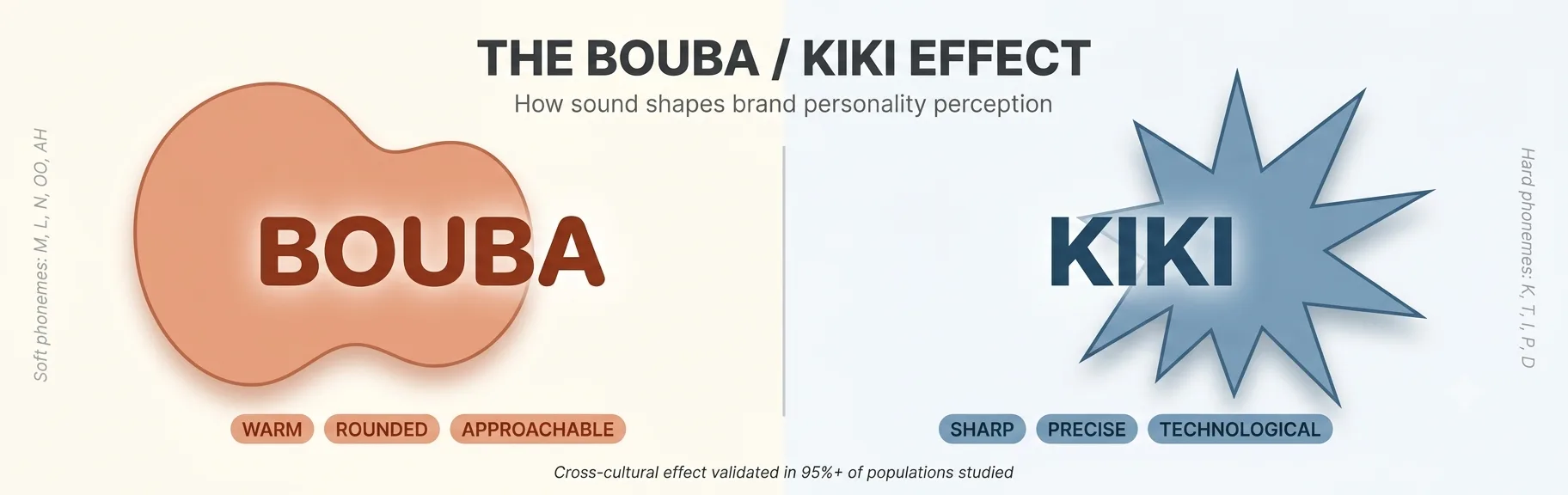
This effect holds across:
- Speakers of unrelated language families
- Literate and pre-literate populations
- Adults and young children
- Sighted and visually impaired individuals
As confirmed by research published across institutions including the University of Birmingham and peer-reviewed journals, these perceptual links between sound and shape appear to be a fundamental feature of human cognition rather than a cultural artifact.
What this means for brand naming:
The Bouba/Kiki framework maps directly onto brand personality dimensions. Consider:
| SOUND TYPE | PHONETIC EXAMPLE | BRAND PERSONALITY SIGNAL |
|---|---|---|
| Rounded (Bouba-type) | “Oo,” “Mm,” “L,” soft vowels | Warm, approachable, organic, friendly |
| Angular (Kiki-type) | “K,” “T,” “I,” hard stops | Sharp, fast, precise, technological |
| Mixed | Combination of both | Complex, multi-dimensional, versatile |
A brand building for warmth and accessibility – a wellness company, a consumer food brand, a community platform – benefits from Bouba-type phonetics. A brand communicating speed, precision, or technological edge benefits from Kiki-type architecture.
Zoom, Stripe, Kik, Twitter – these are Kiki-type names. Loom, Moo, Bumble, Slack – these lean toward the Bouba range. The alignment between phonetic profile and brand positioning is not accidental in the most successful cases.
Consonant Classes: How Plosives and Fricatives Signal Different Brand Personalities
Consonants are the structural backbone of most brand names, and their class carries significant semantic weight. Research published in leading consumer psychology journals confirms that plosive consonants such as [b], [d], [p], [t], [k], and [g] project a sense of action, decisiveness, and energy, while fricatives and approximants such as [f], [s], [v], [l], [m], and [n] project smoothness, continuity, and approachability.
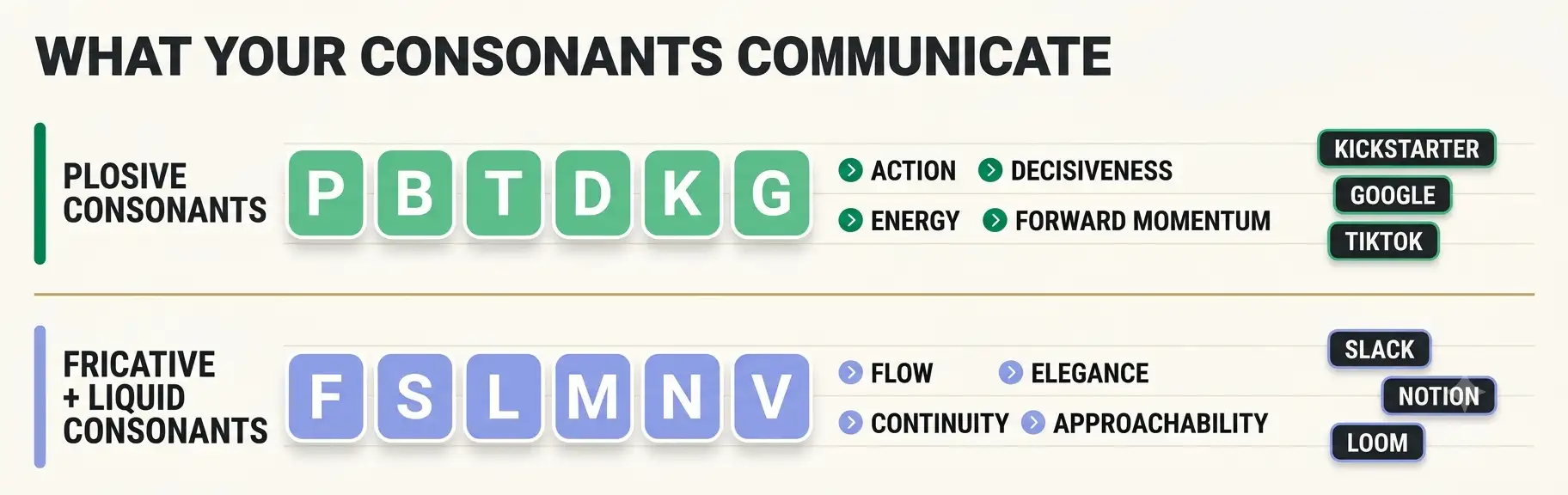
Plosive-Dominant Brand Names
Plosives are produced with a complete closure of the vocal tract followed by a sudden release of air. This articulatory dynamics – the physical act of stopping and releasing – is subconsciously mapped to concepts of force, initiation, and forward motion.
Plosive-dominant names and their associated brand signals:
- Kickstarter – the double plosive [k] and [t] signals launch, momentum, impact
- Google – the hard [g] anchor grounds the name with a sense of structural authority
- Patreon – the initial plosive [p] establishes directness before the softer suffix
- TikTok – [t] and [k] appear four times in four letters, creating relentless percussive energy
Fricative and Liquid-Dominant Brand Names
Fricatives are produced with partial airflow obstruction creating a sustained sound. Liquids ([l], [r]) and nasals ([m], [n]) are produced with smooth, continuous airflow. Both convey flow, elegance, and continuity.
Fricative and liquid-dominant names and their signals:
- Slack – the [sl] cluster and trailing [k] balance flow with a structural anchor
- Notion – the nasal [n] opening and the soft [sh]-like quality conveys fluidity
- Lyft – the liquid [l] opening signals movement and ease before the firm [ft] close
- Aura – pure nasals and open vowels create complete softness and warmth
For founders choosing between domain options, understanding which consonant class predominates in each candidate name provides a direct tool for testing phonetic-brand alignment before any market research.
Vowel Phonetics: What Front and Back Vowels Communicate
Vowels carry the emotional color of a brand name. While consonants establish the structural skeleton, vowels determine the warmth, pitch perception, and scale associations that listeners unconsciously assign to a name.
Front Vowels and High-Frequency Perception
Front vowels – those produced with the tongue positioned toward the front of the mouth, such as the sounds in “ee,” “eh,” and “ih” – produce higher acoustic frequency patterns. The human auditory system maps high-frequency sounds to concepts including:
- Smallness and precision
- Speed and agility
- Sharpness and technical sophistication
- Femininity in certain cultural contexts
Examples of front-vowel-dominant brand names:
- Stripe – the [i] vowel reinforces the precision and clean-edge positioning
- Fitbit – double [i] vowels signal compactness and speed
- Kite – the [ai] diphthong creates a sense of elevation and lightness
Back Vowels and Low-Frequency Perception
Back vowels – produced with the tongue positioned toward the rear of the mouth, such as the sounds in “aw,” “oh,” and “oo” – produce lower acoustic frequency patterns. These map to:
- Largeness, weight, and gravitas
- Depth and authority
- Warmth and familiarity
- Trust and permanence
Examples of back-vowel-dominant brand names:
- Zoom – the [oo] vowel creates a sense of expansive speed through lower-frequency resonance
- Loom – same vowel, similar resonance, reinforcing depth and continuity
- Amazon – the [æ] and [ɒ] vowels anchor the name with vastness
- Shopify – the [o] in “Shop” provides groundedness before the front vowel “-ify” adds energy
The Vowel-Brand Alignment Framework
| BRAND GOAL | IDEAL VOWEL TYPE | EXAMPLE NAMES |
|---|---|---|
| Precision technology | Front vowels: “ee,” “i” | Stripe, Kite, Zipify |
| Authority and scale | Back vowels: “oh,” “aw,” “oo” | Zoom, Amazon, Loom |
| Warmth and community | Mixed with nasal consonants | Notion, Bumble, Luma |
| Speed and energy | Short front vowels + plosives | Kik, Fitbit, Zip |
| Luxury and sophistication | Long vowels + fricatives | Aura, Vela, Sova |
Syllabic Structure and Rhythm: The Hidden Architecture of Memorable Names
Beyond individual phonemes, the syllabic structure and stress pattern of a brand name significantly influence how easily it is processed, recalled, and shared.
Research analyzing over one million domain names and linking their phonological attributes to website performance (published via SSRN) found strong correlations between phonological simplicity – including syllable count and stress regularity – and domain traffic, correct recall, and typing accuracy.
Optimal Syllable Counts
- One syllable: Maximum impact, minimum friction (Stripe, Zoom, Slack, Loom). Ideal for brands prioritizing speed and directness. The risk is limiting expressiveness.
- Two syllables with first-syllable stress (trochaic pattern): The most naturally memorable structure in English. Examples: Google (GOO-gle), Apple (AP-ple), Twitter (TWIT-ter), Shopify is three syllables but follows a similar pattern in recall.
- Three syllables: Can be highly effective if the rhythm flows naturally. Works especially well for brands seeking a more expansive or premium feel: Spotify (SPO-ti-fy), Alibaba (A-li-BA-ba), Patagonia.
- Four syllables and beyond: Memorability declines unless the name has exceptional phonetic flow or cultural familiarity. Consumer recall drops significantly, and brand propagation becomes dependent on visual rather than auditory exposure.
Phonetic Rhythm Patterns
The rhythm of a name – its pattern of stressed and unstressed syllables – also signals brand personality:
- Hard stop at the end (Stripe, Slack, Kik): Communicates decisiveness and completion
- Open vowel ending (Canva, Luma, Aura): Creates a sense of openness and invitability
- Reduplication and repetition (TikTok, Chit Chat, Didi): Creates playfulness and memorability through echo patterns
- Ascending stress pattern (Spo-ti-FY): Creates energy and forward movement
Cognitive Fluency: Why Easy-to-Process Names Build Trust Faster
Cognitive fluency is one of the most powerful and most underappreciated forces in brand naming. In cognitive psychology, fluency refers to the ease with which the brain processes incoming information. High-fluency stimuli feel familiar, trustworthy, and true – even when they are being encountered for the first time.
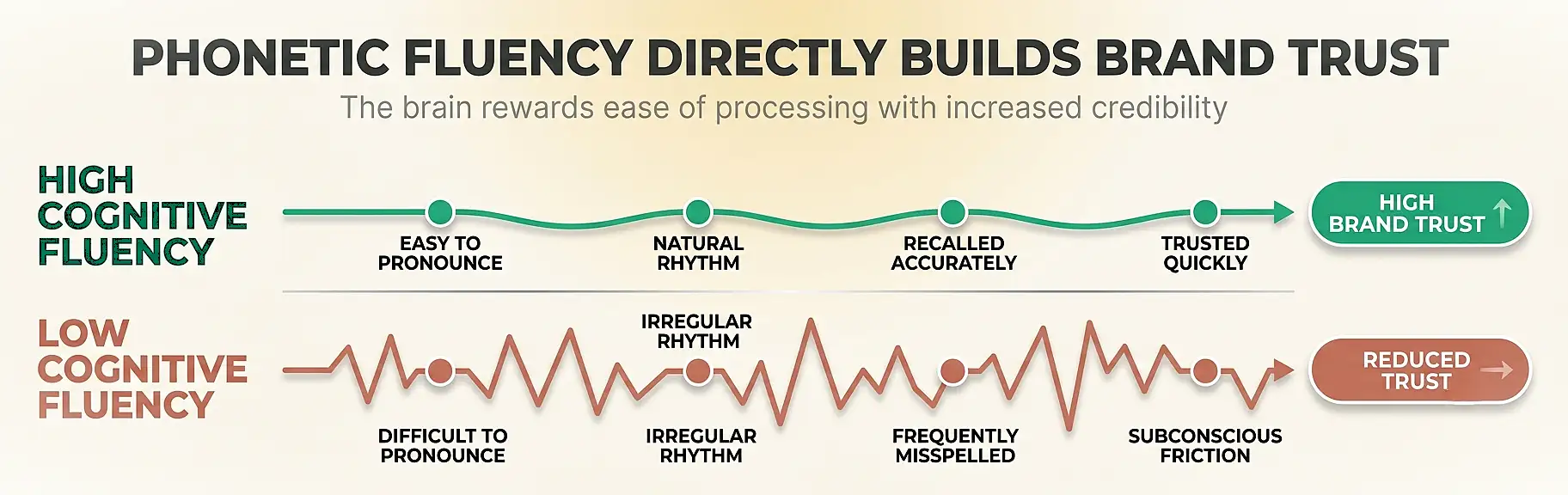
The implications for brand naming are profound. When a name is phonetically smooth – easy to pronounce, naturally rhythmic, free of difficult consonant clusters – the brain processes it with less effort. That reduced processing effort generates a measurable positive affect: the name feels better, safer, and more credible.
Conversely, a name that requires significant phonetic processing effort creates subtle negative affect. The brain interprets the friction as a warning signal, reducing trust and recall, even when the difficulty is purely articulatory.
How cognitive fluency applies to domain naming:
- High-fluency names are consistently rated as more trustworthy and more competent by naive evaluators, independent of actual business quality
- Phonetically awkward names create hidden friction costs in every oral context: sales calls, podcast mentions, word-of-mouth referrals, voice search
- Names with difficult consonant clusters (multiple consecutive consonants, unusual phoneme combinations) score lower on brand recall even after repeated exposure
- Fluent names require less marketing investment to establish because the cognitive work of processing them is lower at every touchpoint
This directly connects to the broader domain strategy question. As explored in the brandable vs. keyword domain analysis, the long-term value of a domain depends heavily on how easily users remember, repeat, and return to it – all of which are phonetic fluency outcomes.
Phonetics in Real-World Brand Names: Case Studies
Examining how the most successful technology brands have – intentionally or otherwise – leveraged phonetic principles reveals consistent patterns worth studying.
Case Study 1: Stripe
The name Stripe is a masterclass in phonetic brand alignment for a fintech company. The initial fricative [str] cluster creates an impression of structured tension – not harsh, but focused. The short [ai] diphthong (front vowel territory) signals precision and speed. The final plosive [p] snaps the name closed with decisiveness. The total phonetic package communicates: fast, precise, reliable, clean. Perfectly aligned with the brand’s actual positioning as a developer-first payment infrastructure.
Case Study 2: Slack
Slack opens with the liquid-fricative cluster [sl] – a sound pattern psycholinguistics associates with smooth, downward, or flowing motion (consider: slide, slip, slick, sleep). The short [æ] vowel keeps it grounded rather than elevated. The final hard [k] anchors it with structural reliability. Together, the phonetics signal: effortless, flowing, dependable – exactly the positioning of a workplace communication tool built to reduce friction.
Case Study 3: Zoom
The single-syllable structure immediately maximizes cognitive fluency. The [z] opening creates a sense of kinetic energy and speed. The [oo] back vowel gives the name unexpected depth – it does not sound thin or fragile. The final [m] nasal close is warm and resonant. The result: a name that sounds both fast and reassuringly substantial, which maps precisely to the experience of instant, high-quality video communication.
Case Study 4: Notion
Notion leverages nasal consonants ([n] appears twice) and soft vowel transitions to project a calm, thoughtful, and organized brand personality. The word also carries semantic cargo – a “notion” is an idea – but the phonetics would work even without the semantic layer. It feels considered and unhurried, which aligns with a productivity tool designed for deep work rather than reactive task management.
Cross-Cultural Phonetics: What Works Globally
One of the most critical and frequently overlooked dimensions of how phonetics shape brand perception is cross-cultural phonetic variance. A name that sounds authoritative and trustworthy in English may carry unintended meanings or prove unpronounceable in Mandarin, Arabic, Hindi, or Portuguese.
Global brand naming requires phonetic due diligence across key target markets.
Key cross-cultural phonetic considerations:
- Mandarin Chinese does not use consonant clusters. Names heavy in English clusters (like “Stripe” or “Sprint”) become phonetically mangled in Mandarin pronunciation, reducing brand integrity in that market.
- Arabic does not include the [p] phoneme natively. Brand names opening with [p] are frequently rendered as [b] by Arabic speakers, creating potential confusion.
- Japanese uses a syllabic structure (mora-based phonology) that appends vowels to most consonant endings. “Slack” in Japanese pronunciation becomes “su-ra-ku” – a very different sonic experience.
- Romance languages generally favor open vowel endings and fluid consonant-vowel alternation. Names ending in hard stops can feel abrupt and unfriendly in those linguistic contexts.
Principles for globally phonetic brand names:
- Prioritize consonant-vowel alternating structures (C-V-C-V patterns)
- Avoid consonant clusters of three or more phonemes
- Choose phonemes that exist natively in major target languages
- Test pronunciation with native speakers in each key market, not translators
- Check for unintended semantic overlap in local languages
Common Phonetic Mistakes in Domain and Brand Naming
Understanding how phonetics shape brand perception also means recognizing the errors that undermine an otherwise strong name. The following mistakes appear frequently in brand naming and domain selection decisions.
Mistake 1: Phonetic misalignment with brand positioning Choosing a name whose sound profile contradicts the brand’s intended positioning. A luxury skincare brand with a name full of hard plosives and short front vowels will fight its own phonetics every day. The sound says “fast and sharp” while the brand needs to say “deep and indulgent.”
Mistake 2: Prioritizing visual appeal over phonetic performance A name may look elegant in a logo but perform poorly in oral contexts. Brand names live in speech just as much as on screens. Voice search, podcast mentions, and word-of-mouth referrals are all phonetic channels. A name that is visually strong but phonetically awkward loses significant distribution efficiency.
Mistake 3: Ignoring consonant cluster difficulty Names with three or more consecutive consonants create articulatory difficulty that reduces fluency, recall, and correct repetition. This is particularly damaging for international audiences.
Mistake 4: Choosing length over phonetic precision Longer names are not inherently more expressive or memorable. Each additional syllable increases the cognitive load of recall. Unless the name has exceptional phonetic flow, every syllable beyond two adds friction.
Mistake 5: Homophone and near-homophone collisions Names that sound like existing words or brands create confusion in auditory contexts. A domain that sounds identical to a competitor, or to a common word with negative connotations, loses brand clarity in every spoken touchpoint.
Mistake 6: Skipping cross-cultural phonetic review For any brand with international ambitions, launching without phonetic testing in key markets is a costly oversight. Rebranding after market entry is significantly more expensive than getting the name right from the start.
Mistake 7: Treating phonetics as a final-stage filter rather than a primary criterion Many naming processes generate candidate names on semantic and visual criteria first, then check phonetics as a late-stage filter. Inverting this process – beginning with phonetic requirements – produces dramatically stronger candidates.
Expert Tips for Phonetically Optimizing Your Brand Name
Whether you are naming a new venture or evaluating domain candidates, these principles will elevate the phonetic quality of your final choice.
Tip 1: Define your phonetic brief before generating names Before brainstorming, write a phonetic brief. Should the name feel sharp or soft? Fast or weighty? Warm or authoritative? Once you have defined the phonetic personality target, you can evaluate candidates against an explicit standard rather than gut feel.
Tip 2: Use the “radio test” for every candidate Record yourself saying the name in a sentence – “Check out [name].com” – and play it back. If a listener who did not see you write it cannot correctly spell the name after hearing it once, the name has failed its phonetic clarity test.
Tip 3: Apply the Bouba/Kiki framework to brand positioning Map your brand’s core personality to the Bouba/Kiki spectrum before evaluating names. Technology platforms, financial tools, and productivity software typically benefit from Kiki-type phonetics. Wellness brands, community platforms, and consumer goods typically benefit from Bouba-type phonetics.
Tip 4: Evaluate vowel-consonant alignment, not just individual phonemes The strongest brand names align their vowel type and consonant class in the same semantic direction. A name using back vowels with plosives sends a mixed message. Back vowels with nasals (Notion, Loom) create coherent warmth and depth. Front vowels with plosives (Stripe, Kik) create coherent speed and precision.
Tip 5: Test recall at 24 and 48 hours Short-term recall does not capture brand name performance. Introduce a candidate name to five non-industry contacts in casual conversation. Check whether they can recall and correctly spell it 24 hours later and again at 48 hours. This longitudinal recall test is far more predictive of real-world brand performance than immediate response.
Tip 6: Check phonetic uniqueness within your category If all major competitors in your space use similar phonetic structures, deliberate phonetic differentiation can create immediate distinctiveness. A fintech space full of plosive-heavy names may benefit from a fluent, nasal-rich name that stands out sonically in every pitch, press mention, and advertisement.
How to Audit a Domain Name’s Phonetic Profile in 6 Steps
Apply this structured audit framework to any domain name you are evaluating.
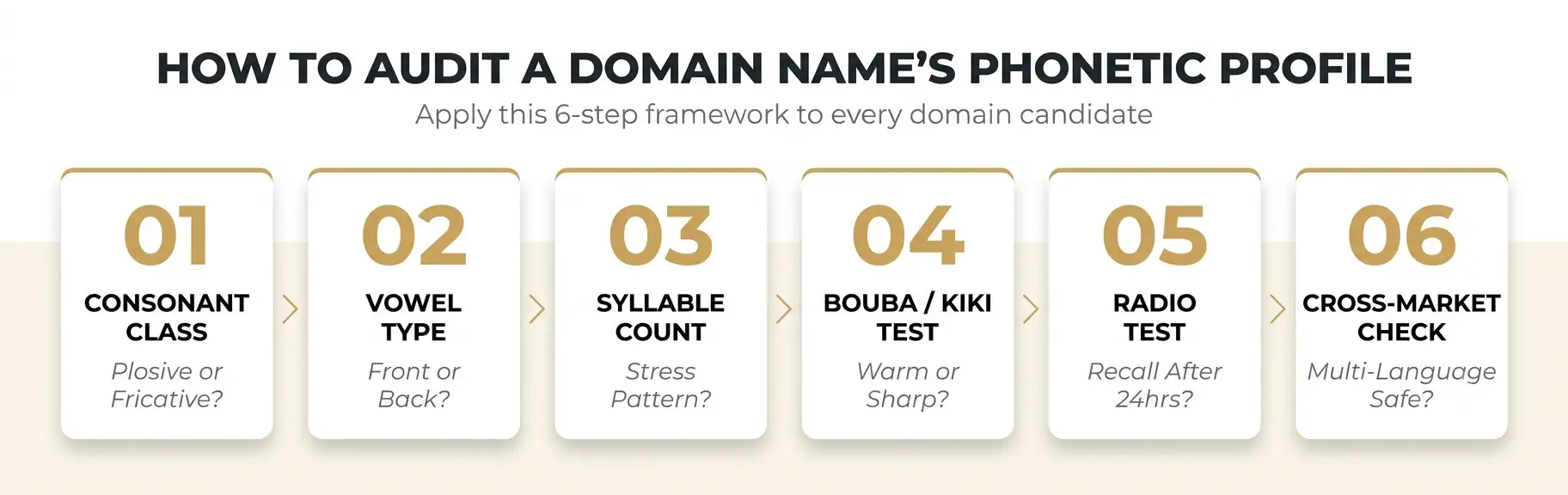
Step 1: Identify the dominant consonant class List all consonants in the name. Classify each as a plosive, fricative, affricate, liquid, or nasal. Determine which class dominates. Map that class to its brand personality signals and check for alignment with your brand positioning.
Step 2: Identify the dominant vowel type Classify all vowels as front (high frequency: “ee,” “ih,” “eh”) or back (low frequency: “aw,” “oh,” “oo”). Check whether the vowel type reinforces or contradicts the consonant class signals and brand positioning.
Step 3: Count syllables and identify stress pattern Count syllables. Identify where the natural stress falls. Check whether the rhythm matches one of the high-memorability patterns (first-syllable stress two-syllable structure being the most reliable).
Step 4: Run the Bouba/Kiki alignment test Based on the phonetic profile, assign the name a position on the Bouba/Kiki spectrum. Compare that position to where your brand intentionally sits on the warmth-sharpness axis.
Step 5: Conduct the radio test Record the domain in a sentence and test it with five people who have not seen it written. Measure correct spelling recall immediately and at 24 hours.
Step 6: Perform cross-market phonetic review If the brand targets multiple language markets, test pronunciation with native speakers in each key market. Identify any consonant clusters that do not exist in target languages, any unintended semantic overlaps, and any phonemes that will be substituted in local pronunciation.
Comparison: Phonetically Strong vs. Phonetically Weak Domain Names
| CRITERION | PHONETICALLY STRONG NAME | PHONETICALLY WEAK NAME |
|---|---|---|
| Syllable count | 1-2 syllables | 4+ syllables |
| Consonant class alignment | Consistent with brand position | Mixed or contradictory |
| Vowel alignment | Reinforces consonant signals | Undermines or neutralizes signals |
| Stress pattern | Regular, first-syllable preferred | Irregular or ambiguous |
| Radio test performance | Correctly spelled by 4 in 5 listeners | Frequently misspelled |
| Cross-market phonetics | Pronounceable in key target languages | Contains language-specific barriers |
| Cognitive fluency score | High – processes easily | Low – requires cognitive effort |
| Bouba/Kiki alignment | Matches brand personality axis | Misaligned or undifferentiated |
| Memorability at 48 hours | High retention | Low retention |
| Uniqueness in category | Phonetically distinct | Phonetically similar to competitors |
Frequently Asked Questions: How Phonetics Shape Brand Perception
Q1: What does it mean that phonetics shape brand perception? Phonetics shaping brand perception means that the specific sounds within a brand name – its consonants, vowels, rhythm, and stress – trigger unconscious cognitive and emotional responses in listeners. These responses influence how audiences perceive the brand’s personality, trustworthiness, speed, warmth, and authority, entirely independent of the word’s literal meaning. Researchers call this phonosemantic mapping or sound symbolism.
Q2: What is the Bouba/Kiki effect in brand naming? The Bouba/Kiki effect is a cross-cultural phonetic phenomenon where rounded, soft sounds (like “bouba”) are universally associated with warmth, openness, and organic qualities, while sharp, hard sounds (like “kiki”) are associated with precision, speed, and technological edge. In brand naming, this framework helps strategists align a name’s phonetic profile with the intended brand personality.
Q3: Do plosive consonants make better brand names than fricatives? Neither class is inherently superior – each serves different brand positioning goals. Plosive consonants (p, b, t, d, k, g) signal action, force, decisiveness, and energy. Fricatives and liquids (f, s, l, m, n) signal flow, elegance, and approachability. The best brand names align their dominant consonant class with the brand’s intended personality and category positioning.
Q4: How many syllables should a brand name or domain have? Two syllables with first-syllable stress (the trochaic pattern) is the most consistently high-performing structure for brand memorability in English. One-syllable names maximize impact and fluency. Three syllables can be highly effective with natural rhythm. Beyond three syllables, memorability declines significantly unless the phonetic flow is exceptional.
Q5: Why does cognitive fluency matter for brand naming? Cognitive fluency refers to the ease with which the brain processes a piece of information. High-fluency names – those that are easy to pronounce, naturally rhythmic, and free of articulatory difficulty – are consistently rated as more trustworthy and credible, even on first encounter. This means phonetically smooth domain names build trust faster and require less marketing investment to establish.
Q6: How does phonetics affect domain name SEO and traffic? Phonetically strong domain names generate higher direct navigation traffic because users remember and correctly type them. They also drive more branded search volume over time, which is a positive engagement signal to search engines. Research analyzing over one million domains found strong correlations between phonological simplicity and realized website traffic, independent of keyword relevance.
Q7: How do I test whether a domain name is phonetically effective? Apply the radio test: record yourself saying the domain in a sentence, play it to five people who have not seen it written, and measure whether they can correctly spell and recall it 24-48 hours later. Additionally, classify the name’s consonant class and vowel type, check its Bouba/Kiki alignment against your brand positioning, and test pronunciation with native speakers in your key international markets.
Q8: Are there domain marketplaces that apply phonetic principles to naming? Yes. Specialist brandable domain platforms curate names based on phonetic quality, memorability, and brand alignment rather than keyword matching. Aotiv focuses specifically on premium brandable domains built for long-term brand equity – including names selected for phonetic resonance, trademark eligibility, and cross-market viability.
Conclusion
How phonetics shape brand perception is one of the most powerful – and most consistently underutilized – levers available to brand builders and founders. The evidence is unambiguous: sound is not neutral. Every phoneme in your domain name sends a signal to every brain that encounters it, whether in a pitch, a podcast, a search result, or a word-of-mouth referral.
The founders behind Stripe, Slack, Zoom, Notion, and Spotify did not accidentally choose names that sound exactly like what they do. The phonetic architecture of these names is either the product of deliberate linguistic strategy or of exceptional intuition – and in either case, the names have compounded in value precisely because they work at the level of human auditory cognition.
Getting the phonetics right does not guarantee brand success. However, getting them wrong introduces a persistent, invisible friction cost into every single customer touchpoint for the entire life of the business.
The best time to make a phonetically informed naming decision is before you register the domain. The second best time is now.
If you are ready to find a domain name engineered to resonate, browse Aotiv’s premium brandable domain collection and start with a name your audience will remember from the first time they hear it.
Pingback: When to Rebrand Your Domain Name: 8 Clear Signals