
A startup name domain strategy works only when domain selection happens before the business plan, not after it. Founders who write their plan first often discover their chosen name is already taken, trademarked, or unusable as a .com, forcing costly rebrands months into operation. Locking in the domain early protects brand identity, SEO equity, and investor perception from day one.
That single decision – domain first, plan second – separates startups that scale smoothly from those that burn weeks renaming pitch decks, email addresses, and social handles. Founders obsess over market sizing, unit economics, and go-to-market channels, yet treat the domain as an afterthought, something to “sort out later.” Later usually means after the name is already printed on a term sheet, a logo, and a LinkedIn page. If you’re building a company you can explore the curated marketplace of brandable domains to see what’s realistically available before you commit a single sentence of your business plan to a name you may not be able to own.

This article breaks down exactly why sequencing matters, what happens when founders get it backward, and how to build a startup name domain strategy that holds up through fundraising, scaling, and eventual exit.
What is a Startup Name Domain Strategy?
A startup name domain strategy is the deliberate process of evaluating domain availability, trademark conflicts, phonetic strength, and brand extensibility before finalizing a company name. Instead of naming a business and then hoping a matching domain exists, founders reverse the order: they shortlist names based on what domains are actually purchasable, then build the business plan, pitch deck, and legal entity around a name they can fully own online.
In short, it answers one question before anything else gets written: can this name become a real, ownable, defensible web presence?
Key elements of a sound startup name domain strategy include:
- Domain availability across the exact-match .com and relevant alternative extensions
- Trademark clearance to avoid conflicts that could force a rebrand later
- Phonetic and linguistic testing so the name is easy to say, spell, and remember
- Brand extensibility to confirm the name still works as the company adds products or enters new markets
- SEO and search intent alignment so the domain doesn’t compete against unrelated, unrelated, or negative search results
Why Domain Selection Should Precede Your Business Plan
Most business plan templates ask founders to define the problem, the solution, the market, and the financial model long before they ask about the domain. That ordering is backward for any startup planning a serious digital presence, because the name and domain influence nearly every section that follows.
The Cost of Retrofitting a Business Plan Around a Taken Domain

Imagine spending six weeks refining a business plan around the name “Lumina,” only to discover LuminaHQ.com is the best available option because Lumina.com sold years ago for a five-figure sum. Suddenly your pitch deck, your email signatures, and your investor one-pager all need updating. Worse, your SEO strategy now has to compete against an entirely different, more established “Lumina” brand that already ranks for your target keywords.
Rebrands after launch are not cheap. According to research summarized by the U.S. Small Business Administration,
a large share of new businesses fail within their first few years, and unnecessary friction – like a mid-launch rebrand – only adds avoidable risk during an already fragile period.¹ When a startup has to swap its domain after acquiring even a small amount of traffic or backlinks, it effectively resets its search visibility to zero.
How Domain Availability Shapes Market Positioning

A domain isn’t just a web address; it’s often the first and most repeated brand touchpoint a customer encounters. If the exact-match .com is unavailable, founders are forced into workarounds: adding “get,” “try,” or “hq” as a prefix, switching to a .io or .co extension, or picking an entirely different name. Each workaround changes how memorable, trustworthy, and typeable the brand becomes.
Choosing the domain first means the business plan can be written around a name that is already secured, positioned, and search-friendly, rather than reverse-engineered around whatever happens to still be free.
How a Startup Name Domain Strategy Affects Fundraising
Investors read domains the same way customers do, only with a more critical eye. During due diligence, a mismatched or clunky domain can quietly raise questions about how carefully the founding team plans ahead. A startup pitching itself as “Nexora” while operating on GetNexoraApp.com sends a small but real signal: the team either didn’t check availability early or couldn’t secure the name they wanted.

This matters more than founders expect, because:
- Pitch decks and data rooms reference the domain repeatedly, so any awkwardness in the URL gets seen dozens of times by the same investor.
- A clean, matching domain photographs well in screenshots, email signatures, and press mentions that investors will eventually search for.
- Rebranding mid-raise disrupts momentum, forcing founders to explain a name change instead of focusing the conversation on traction and metrics.
None of this means a startup needs a seven-figure domain to raise capital. It means the domain conversation belongs in the earliest founder discussions, alongside the pitch narrative, not bolted on afterward.
International and Multi-Market Naming Considerations
A startup name domain strategy also needs to account for how a name travels beyond its home market. A word that sounds sharp and modern in English can carry an awkward or even negative meaning in another language, and a domain that’s easy to type on a U.S. keyboard layout may be harder to communicate verbally in markets with different phonetic conventions.

Founders planning to expand internationally, even years down the line, should:
- Check the name against common languages in target expansion markets, not just the home market
- Confirm the .com is truly global-friendly, since some country-specific extensions carry local registration restrictions
- Test verbal delivery over a phone call, not just written spelling, since many international customers will first hear the name before they see it written down
The Hidden Risks of Naming Your Startup Before Checking Domain Availability
Founders who skip a startup name domain strategy commonly run into these problems:
- Trademark collisions discovered only after the name appears on legal filings, incorporation documents, or a signed lease
- Domain squatting, where a taken domain is being held for resale at a price far above what a bootstrapped startup can justify
- SEO cannibalization, where an unrelated but similarly named company already dominates search results for the exact business name
- Social handle mismatches, where the domain is technically available but every matching social handle is taken, splintering the brand across inconsistent usernames
- Investor perception issues, since a sloppy or unavailable domain can signal a lack of preparation during due diligence
A related risk worth flagging: even when a name feels perfect, the underlying sound and structure of the word shapes how customers perceive the brand before they read a single word of copy. Getting the domain locked in early gives founders time to test that phonetic reaction with real users instead of discovering it too late.
A Realistic Scenario: Two Founders, Two Different Outcomes
Consider two early-stage founders launching competing products in the same category, both starting from a blank page.

The first founder writes a full business plan over three weeks, complete with financial projections, a go-to-market section, and a name chosen because it “felt right” during a late-night brainstorm. Only after the plan is finished does the founder check domain availability, discovering the .com is owned by an unrelated company with no interest in selling. The founder settles for a hyphenated alternative, then spends the next month updating every document, slide, and account created under the original name.
The second founder spends two days shortlisting names, checking availability, and testing pronunciation with a handful of outside contacts before writing a single page of the business plan. By the time the plan is drafted, the name and domain are already locked in, the trademark search has come back clean, and the founder can move straight into building rather than backtracking.
Both founders end up with a working business, but one spent extra weeks on avoidable cleanup while the other used that same time to talk to customers and refine the product. This is the practical difference a startup name domain strategy makes: it isn’t about perfection, it’s about sequencing effort so it isn’t wasted.
Step-by-Step: Building Your Startup Name Domain Strategy
Founders don’t need a branding agency to get this right. A structured, repeatable process works just as well for a solo founder as it does for a funded team.
- Draft a shortlist of 15-20 candidate names based on the core value proposition, not the final business plan wording.
- Run each name through a domain availability check, prioritizing the exact-match .com, followed by .io, .co, and .ai depending on the industry.
- Screen for trademark conflicts using an official trademark database before falling in love with any single option.
- Test pronunciation and spelling with at least ten people outside the founding team who have no prior context.
- Check social handle availability across the platforms most relevant to the target customer base.
- Confirm search engine neutrality, meaning the name doesn’t return pages of unrelated results that will bury the startup’s own content.
- Secure the domain immediately once a finalist is chosen, even before incorporation paperwork is filed.
- Only then begin writing the business plan, incorporation documents, and pitch materials around the confirmed name.
Brandable vs Keyword Domains: Which Fits Your Startup Name Domain Strategy?
One of the earliest forks in any startup name domain strategy is choosing between a brandable domain and a keyword-based domain. Founders deciding between the two should read this detailed comparison of brandable versus keyword domains before shortlisting names, since the right choice depends heavily on the business model.
| Factor | Brandable Domain | Keyword Domain |
|---|---|---|
| Memorability | High – short, distinctive, easy to recall | Moderate – descriptive but often generic-sounding |
| SEO impact | Built through content and backlinks over time | Some immediate relevance signal, though Google weights this less than in prior years |
| Trademark strength | Easier to trademark and defend | Harder to trademark since descriptive terms have weaker protection |
| Scalability | Extends naturally to new products or markets | Can box the company into one narrow niche |
| Investor perception | Reads as a “real” company name | Can read as a lead-generation site rather than a brand |
For most venture-backed or scale-oriented startups, a brandable domain wins because it supports the company as it grows beyond its first product. Keyword domains still have a place for niche, single-purpose tools, but they rarely age well as a company’s ambitions expand.
Common Mistakes Founders Make With Startup Naming and Domains
Even experienced founders fall into predictable traps when they don’t treat this as a formal process:
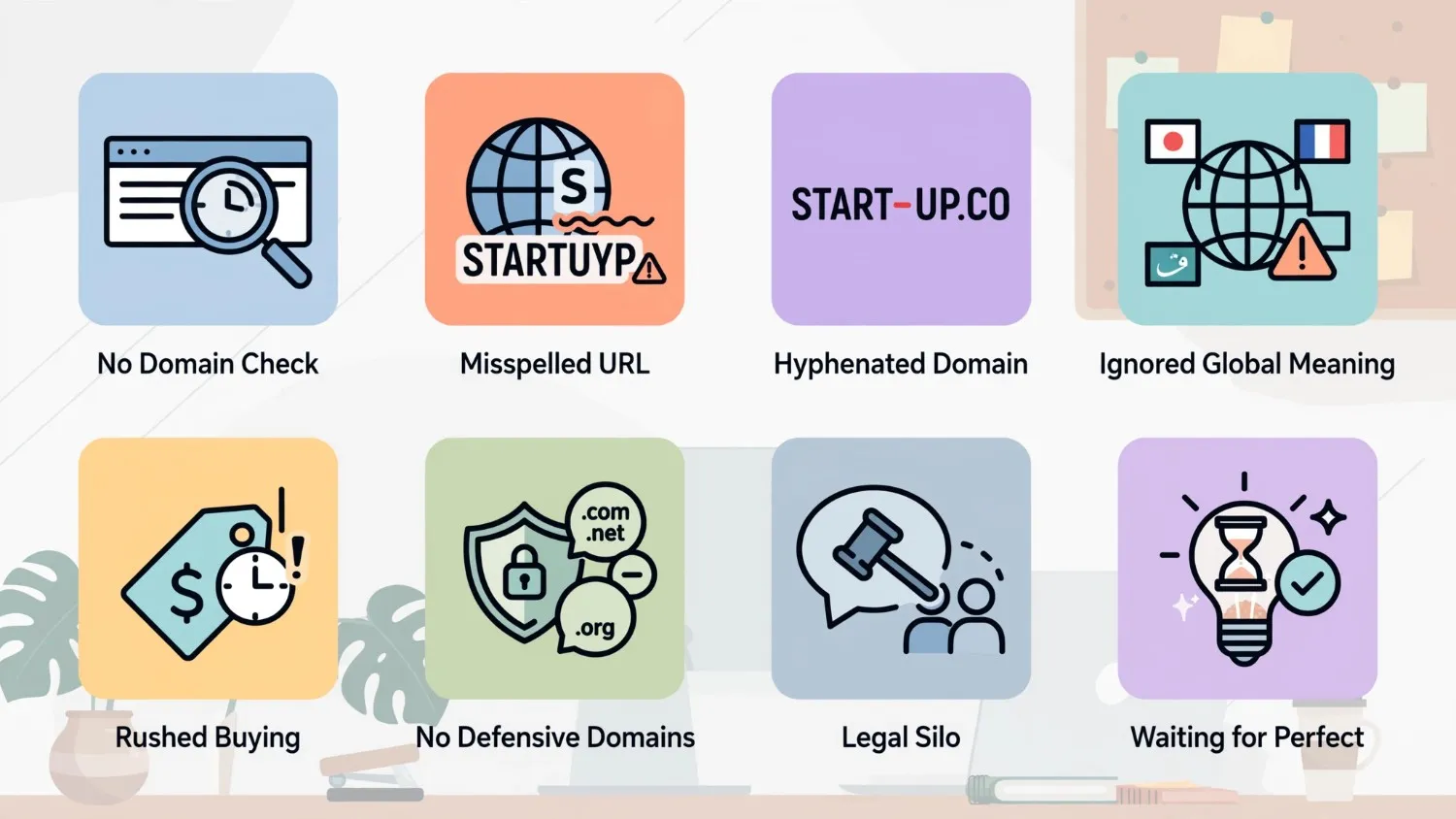
- Choosing a name before checking any domain availability at all, assuming a workaround will exist later
- Settling for a misspelled or hyphenated domain because the clean version was taken, which increases customer confusion
- Ignoring international considerations, where a name may carry an unintended meaning in another language or market
- Overpaying under time pressure because a fundraising deadline forced a rushed decision
- Failing to secure defensive domain variations, leaving competitors free to register close misspellings of the brand
- Treating the domain as a technical afterthought rather than a core piece of brand strategy owned by the same team shaping the business plan
- Letting the legal team choose the name in isolation, without looping in whoever owns marketing and product, which often produces a name that’s legally clean but commercially forgettable
- Assuming a low domain price means low quality, when in reality pricing often reflects age, extension, and prior use rather than how well the word fits the brand
- Waiting for “the perfect name” instead of shipping with a strong, available option and refining brand voice over time
Each of these mistakes shares a root cause: naming gets treated as a creative exercise disconnected from the practical reality of what’s actually purchasable. A startup name domain strategy closes that gap by forcing availability checks to happen at the same time as creative brainstorming, not after.
Expert Tips for a Future-Proof Startup Name Domain Strategy
Founders who get this right tend to follow a few consistent habits:
Buy before you need it.
The best time to secure a domain is the moment it’s chosen as a finalist, not after legal review is complete.
Budget for premium domains early.
A well-matched brandable domain is a long-term brand asset, not a sunk marketing cost.
Keep a short list of backups.
If the ideal name’s domain is unavailable or overpriced, having two or three strong alternatives prevents rushed decisions.
Involve someone outside the founding team in name testing.
Founders are often too close to a name to notice pronunciation or spelling friction.
Reassess extensibility at every funding round.
A name that worked for an MVP may not carry the same weight once the company expands into adjacent markets.
Document the decision process.
Keeping a short record of why a name was chosen, including the domains that were considered and rejected, helps future hires and investors understand the brand’s origin story.
Separate legal naming from marketing naming when needed.
Some startups incorporate under one legal entity name while operating publicly under a distinct brand name and domain; understanding this distinction early prevents confusion during contract negotiations.
Revisit the domain strategy before every major campaign.
Paid acquisition, PR pushes, and partnership announcements all perform better when the domain behind them is clean, short, and easy to repeat on camera or on air.
Timing the Purchase: Before, During, or After Incorporation?
A common question founders ask is whether the domain should be purchased before or after the company is legally incorporated. In almost every case, the domain should be secured first. Incorporation can be delayed a few days without meaningful cost, but a domain sitting unclaimed for even 48 hours can be registered by someone else, including domain investors actively monitoring newly trending business names.
A practical sequence looks like this:
- Finalize the name shortlist
- Purchase the strongest available domain immediately
- File for trademark protection
- Complete incorporation paperwork using the now-secured name
- Build the business plan, pitch deck, and website around the confirmed identity
Buying vs Building: When to Purchase a Premium Brandable Domain
Some founders assume premium domains are reserved for companies with large marketing budgets, but that’s rarely true anymore. A first-time buyer who understands the process can navigate a brandable domain purchase with far less friction than expected, particularly when the purchase happens early, before the name is tied to legal filings or paid advertising.
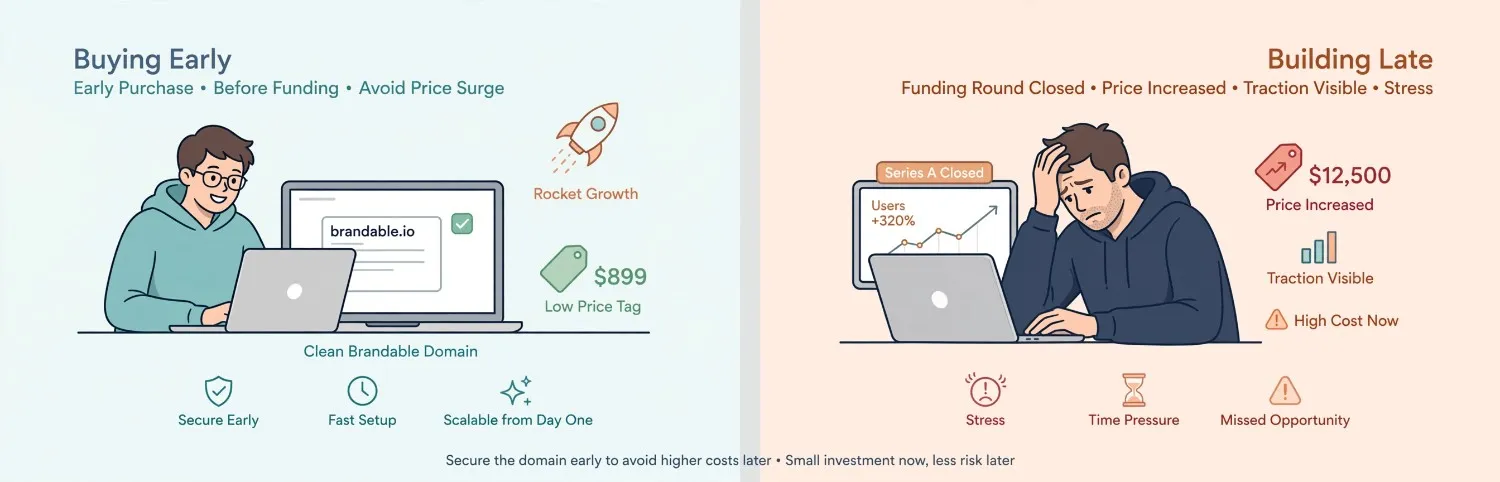
Buying early also avoids a common trap: waiting until after a funding round closes, when a domain’s asking price may have already increased due to visible traction or public interest in the space the startup occupies.
When (and How) to Sell or Pivot Your Startup Domain
A startup name domain strategy isn’t only about acquisition. Founders occasionally pivot, rebrand, or shut down, leaving a domain that no longer fits the business. In these cases, understanding how to sell a brandable domain properly can recover meaningful value from what would otherwise be a sunk cost. Treating the domain as a real asset – something with resale value, not just a technical utility – is part of thinking about naming strategically from the start.
Founders who want the fuller picture of what actually makes a domain “brandable” in the first place should also review this complete guide to brandable domains, which covers the criteria buyers and investors use to judge domain quality.
Startup Name Domain Strategy Checklist
Use this quick-reference table before finalizing any startup name:
| Task | Status Check |
|---|---|
| Exact-match .com available | Confirmed / Not confirmed |
| Trademark search completed | Confirmed / Not confirmed |
| Pronunciation tested with outside group | Confirmed / Not confirmed |
| Social handles checked | Confirmed / Not confirmed |
| Search results reviewed for conflicts | Confirmed / Not confirmed |
| Domain purchased or under offer | Confirmed / Not confirmed |
| Business plan drafted around confirmed name | Confirmed / Not confirmed |
Trademark screening should always reference an official source rather than a quick search engine check. The USPTO’s Trademark Electronic Search System is the authoritative starting point for U.S.-based founders, while international startups should check their relevant national trademark office alongside a global search. Domain ownership and registration details can also be verified through ICANN’s Lookup tool, which confirms who currently holds a domain and when it’s due to expire.
Frequently Asked Questions
What is a startup name domain strategy?
A startup name domain strategy is the process of checking domain availability, trademark conflicts, and brand fit before finalizing a company name, rather than after the business plan is already written.
Why should I choose my domain before writing my business plan?
Choosing the domain first prevents a costly rebrand later, protects SEO equity from day one, and ensures the business plan is built around a name the company can actually own online.
What extensions should startups consider besides .com?
While an exact-match .com remains the strongest default, .io, .co, and .ai have become widely accepted alternatives in tech and startup circles when the .com is unavailable.
How do I check if a startup name is trademarked?
U.S. founders can search the USPTO’s trademark database directly, while international founders should check their relevant national trademark office and consider a broader global trademark search before finalizing a name.
Should I buy a premium brandable domain even as a bootstrapped startup?
Yes, when possible. Securing the right domain early, before public traction increases its resale value, is typically far cheaper than waiting and often cheaper than a later rebrand.
Can a startup change its domain after launch without hurting SEO?
It’s possible with proper redirects and a migration plan, but it almost always causes a temporary drop in search visibility and requires rebuilding backlink equity, which is why getting the name right the first time matters.
How much of the business plan depends on the domain being confirmed first?
More than most founders assume. Sections covering brand positioning, marketing channels, and go-to-market messaging all reference the company name directly, so locking in the domain first prevents having to rewrite those sections later.
What’s the difference between a brandable domain and a generic business name with any available extension?
A brandable domain is chosen specifically for memorability, phonetic strength, and long-term flexibility, while a generic name paired with whatever extension happens to be free is usually a compromise made under time pressure rather than a deliberate strategic choice.
Put the Domain First, Then Build the Plan
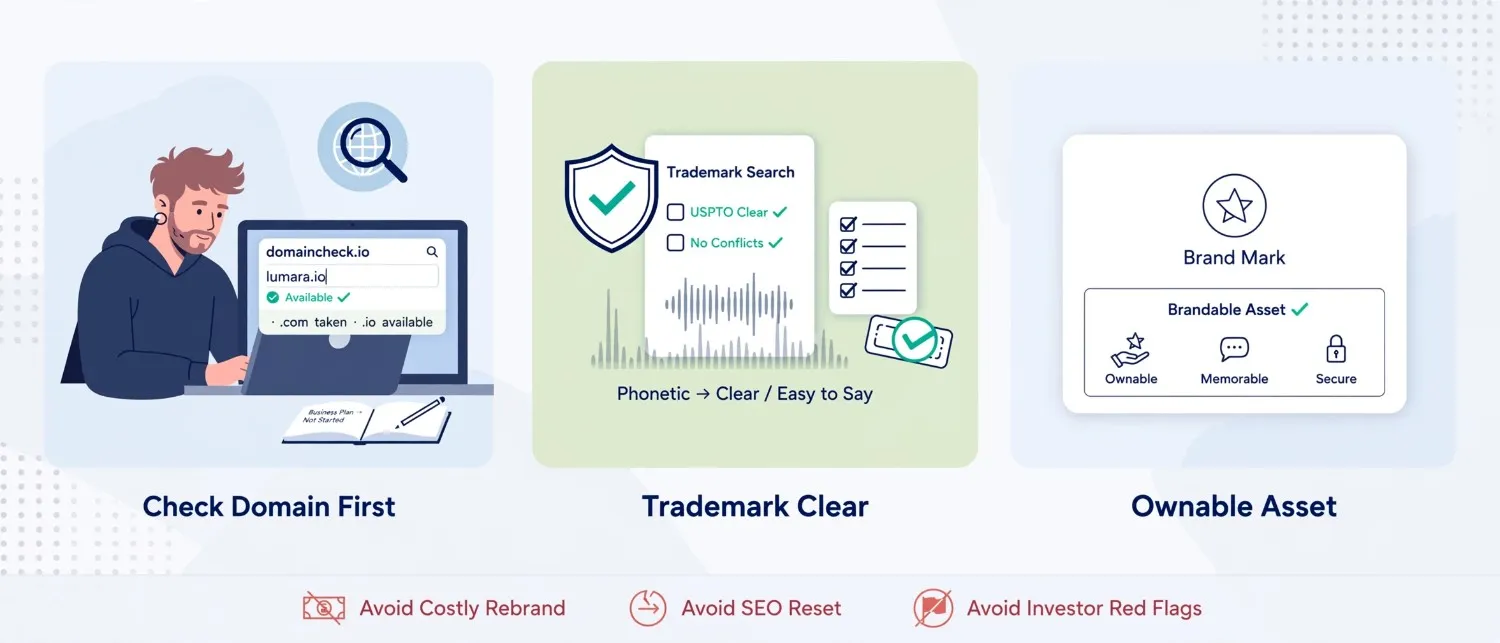
A startup name domain strategy only works when it happens at the very beginning of the process, not as a last-minute check before launch. Founders who confirm domain availability, trademark clearance, and phonetic strength before writing a single page of their business plan avoid the costly rebrands, SEO resets, and investor red flags that come with naming a company backward. The name becomes a real, ownable asset instead of a placeholder that might not survive contact with reality.
If you’re at the naming stage right now, don’t wait until the business plan is finished to find out your ideal name isn’t available. and secure the right name before you write another word of your plan.