
Brandable domains for tech startups function as pre-launch trust signals: a short, ownable name gives a founder credibility with users, press, and investors before a single line of product copy exists. Startups that secure a distinctive domain early can build waitlists, media coverage, and category recognition months ahead of their competitors. This naming decision, made before the business plan is finalized, often determines whether a startup looks established or improvised on day one.
Every founder eventually faces the same question: what do we call this thing before anyone has used it? Long before the product ships, the domain name is already doing work – shaping first impressions, anchoring a pitch deck, and setting the tone for every press mention that follows. That is exactly why choosing a startup name and domain strategy before the business plan has become standard practice among founders who understand how much authority a name can carry before launch.
For startups specifically, this decision carries extra weight. A tech company usually has no physical storefront, no legacy reputation, and often no revenue yet – so the domain becomes one of the only tangible assets a stranger can evaluate. Consequently, brandable domains for tech startups have become a deliberate, budgeted line item rather than an afterthought squeezed in during the final week before launch.
This article walks through why brandable naming works, how founders use it across the pre-launch runway, the mistakes that undercut the strategy, and a practical, step-by-step approach for picking a name that earns trust before the product does.
Naming decisions used to be treated as a creative afterthought, something handled in a weekend brainstorm once the product roadmap was locked. That approach no longer holds up in a market where dozens of similarly-featured tools launch every month. Founders now recognize that the domain is often the very first data point a stranger uses to judge whether a company is worth their attention, and that judgment happens in seconds rather than minutes.
What is a Brandable Domain, and Why Does It Matter for Startups?
A brandable domain is a short, memorable, ownable web address built to function like a brand name rather than a literal description of a service. Unlike keyword-stuffed domains such as “besttaskappforteams.com,” a brandable domain such as Asana, Notion, or Stripe carries no inherent meaning until a company fills it with one.
For a full breakdown of the category, the guide on what makes a domain qualify as brandable covers the naming patterns in more depth. In short, brandable names typically share a few traits:
- Short and pronounceable, usually under three syllables
- Free of hyphens, numbers, or awkward spelling
- Flexible enough to grow beyond the startup’s first product
- Emotionally or phonetically distinct, rather than generic
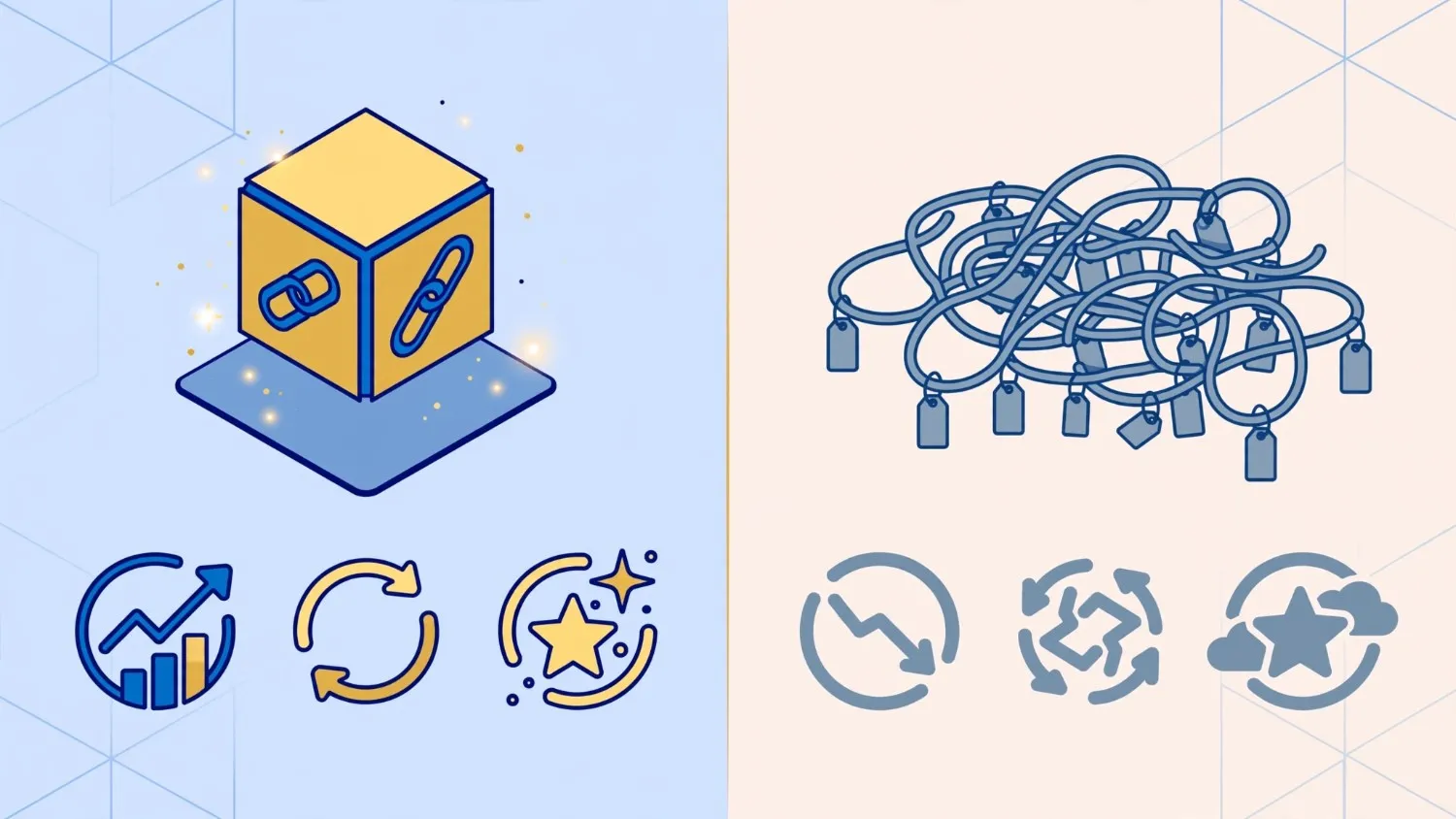
Because these names are not tied to a single keyword, they scale as the company pivots – a real advantage for early-stage tech startups whose first product idea rarely survives contact with the market unchanged.
Why Tech Startups Specifically Benefit from This Category
Tech startups pivot more frequently than businesses in almost any other sector. A team that starts building a scheduling tool may end up pivoting into a broader productivity suite within eighteen months. A brandable name absorbs that change gracefully, while a literal keyword domain forces an uncomfortable choice: keep a name that no longer describes the product, or spend money and momentum on a rebrand.
There is also a competitive dimension. In categories like artificial intelligence, fintech, and developer tooling, dozens of companies now launch with nearly identical feature sets. When the underlying product is difficult to differentiate in the first few months, the name frequently becomes the most memorable distinguishing asset a startup has – the first thing a user repeats to a colleague, and the first thing a journalist types into a headline.
Why Brandable Domains for Tech Startups Build Authority Before Launch
Trust is the scarcest resource a pre-launch startup has. There is no customer base to point to, no case studies, and often no press coverage yet. Brandable domains for tech startups solve part of this problem indirectly: a polished, well-chosen name signals that the founders are serious, funded, and thinking beyond an MVP.
Consider what a domain communicates before a visitor reads a single sentence of copy:
- Professionalism – a clean, brandable name suggests the company invested in its identity.
- Category confidence – names like Uber or Zoom claim a category rather than describing a feature, implying ambition.
- Memorability – if a journalist or investor can recall the name after one meeting, referrals become easier.
- Longevity – a name untethered from one product feature won’t need replacing after a pivot.
None of this replaces a strong product. However, it does mean that a startup’s very first impression – often formed via a shared link, a cold email signature, or a conference badge – carries more weight than founders tend to expect.
Think about how often a startup’s name travels without its product attached. A founder mentions the company name at a networking event, a friend forwards a link without context, or a journalist writes a single-sentence mention in a roundup article. In every one of these moments, the name is doing all the persuasive work by itself. If it sounds improvised, generic, or difficult to spell, that impression sticks well before anyone visits the actual site.
This is precisely why so many well-funded startups treat their domain purchase with the same seriousness as their first hire. A name is rarely revisited once the company gains traction, so getting it right early avoids a far more expensive correction later – both in direct rebranding costs and in the lost equity of any early recognition already built around the original name.
The Psychology of Trust: How Domain Names Shape First Impressions
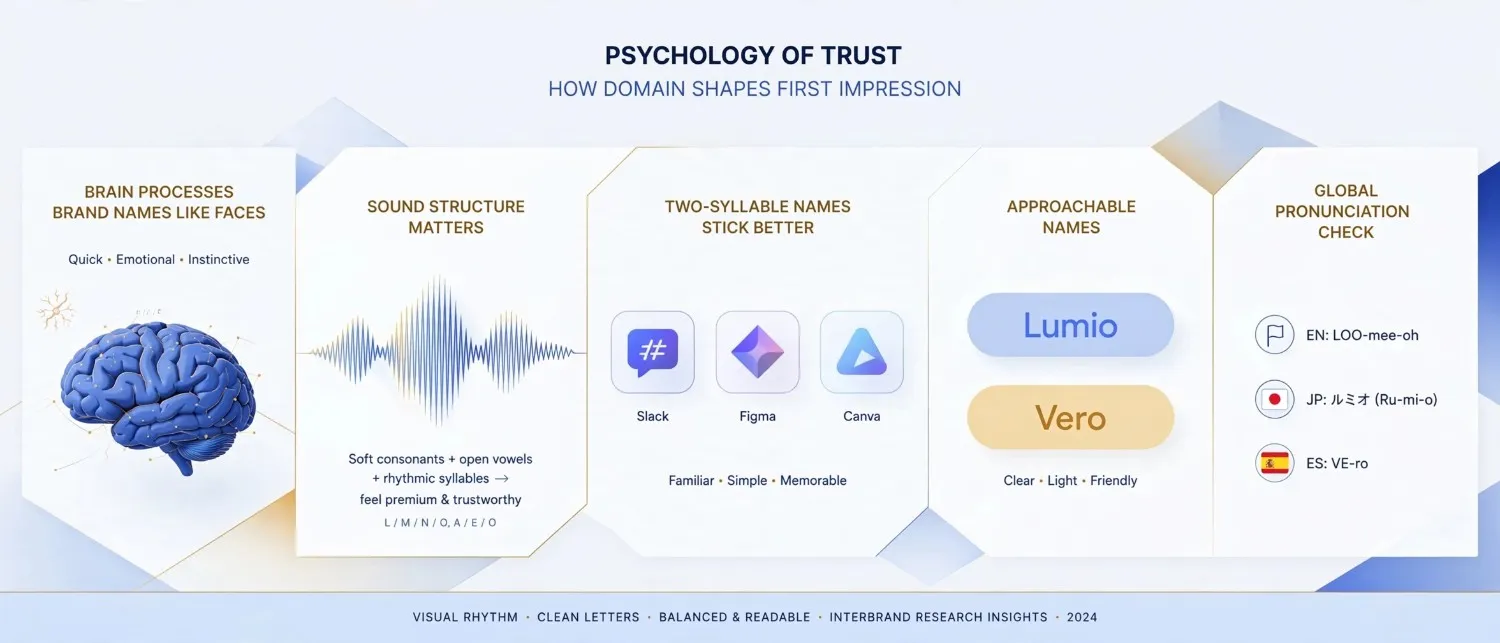
Human brains process brand names the way they process faces: quickly, emotionally, and with lasting bias. A domain that sounds invented, clumsy, or overly literal can subconsciously read as amateur, even if the underlying product is excellent.
This is partly a matter of sound. The guide on how phonetics shape brand perception explains why certain sound patterns – soft consonants, open vowels, rhythmic syllables – tend to feel more trustworthy or premium to listeners. Startups that ignore this dynamic often end up with names that are legally available but perceptually forgettable.
A few patterns recur across successful tech naming:
- Two-syllable names tend to stick better in verbal pitches (“Slack,” “Figma,” “Canva”).
- Soft plosives and open vowels (“Aotiv,” “Lumio,” “Vero”) often read as approachable rather than clinical.
- Avoiding literal keywords protects against sounding like a feature rather than a company.
For further outside reading on how naming interacts with brand psychology, the Interbrand best global brands research is a useful reference point, since it tracks how naming and identity consistency correlate with long-term brand value.
This sound-based bias is not unique to English-speaking markets either. Startups planning international expansion often test names across several languages specifically to avoid unintended meanings or awkward pronunciations abroad. A name that sounds premium in one market can sound clumsy, or even mean something unintended, in another. Consequently, many founders now run a quick multilingual pronunciation check as part of their naming shortlist process, well before committing to a final domain purchase.
Beyond sound, visual rhythm matters too. Names with clean letter patterns – avoiding repeated double letters, silent characters, or ambiguous spellings – tend to perform better in verbal contexts like podcasts, conference talks, and word-of-mouth referrals, where a listener has to reconstruct the spelling purely from how it sounds.
Brandable Domains vs Keyword Domains: Which Fits a Startup Launch Strategy?
Founders often debate whether to buy a keyword-heavy domain for quick SEO wins or a brandable name for long-term identity. The full comparison lives in the guide on brandable versus keyword domains, but the short answer for most venture-backed tech startups is that brandability wins once investor pitches, press, and hiring enter the picture.
| Factor | Brandable Domain | Keyword Domain |
|---|---|---|
| First impression | Feels like an established company | Feels like a niche tool or affiliate site |
| Flexibility after a pivot | High – name isn’t tied to one feature | Low – name may describe a product you abandon |
| Investor perception | Reads as founder-led, intentional branding | Can read as SEO-first, product-second |
| Trademark potential | Easier to trademark distinctively | Often difficult due to generic terms |
| SEO advantage at launch | Minimal, earned over time | Some immediate keyword relevance |
| Long-term scalability | Grows with the company | Often requires a rebrand later |
Keyword domains still have a place, particularly for single-purpose tools chasing search traffic quickly. But for a startup trying to build a durable, fundable identity, a brandable domain typically holds up better once the company expands beyond its original pitch.
There is also a hiring dimension worth considering. Early employees, contractors, and advisors often research a company by its domain before they research the founders. A confident, brandable name reads as a company built to last, which subtly affects recruitment conversations even before an offer is discussed. Keyword domains, by contrast, can occasionally signal a side-project mentality, even when the underlying team and funding are perfectly serious.
Additionally, trademark law tends to favor distinctive, invented names over descriptive ones. Generic or keyword-heavy domains are harder to protect legally, since trademark offices generally grant stronger protection to names that do not simply describe the product category. This becomes especially relevant once a startup starts fundraising seriously, as investors and legal counsel increasingly ask about trademark defensibility during due diligence.
How Tech Startups Use Brandable Domains Across the Pre-Launch Journey
Founders rarely buy a domain and simply wait for launch day. Instead, the name becomes active infrastructure well before the product exists.
Building a Waitlist Page That Looks Established
A brandable domain hosting a simple waitlist page – logo, one-line pitch, email capture – already looks like a real company. Visitors rarely question whether a startup is legitimate when the domain itself feels considered rather than improvised.
Establishing Category Ownership Early
Startups entering a crowded space (AI tools, fintech, developer platforms) often use a distinctive brandable name specifically to avoid blending into a sea of literal, keyword-based competitors. Owning a name nobody else can claim becomes a small moat in itself.
Investor and Press Credibility
Journalists and investors see dozens of pitches weekly. A name that is easy to say, spell, and remember increases the odds of a follow-up mention, a shared link, or a repeat introduction. Since coverage often happens before the product is fully built, the domain frequently becomes the only “product” a reporter can actually visit.
Consistent Identity Across Recruiting and Partnerships

Beyond users and press, a brandable domain also does quiet work during early recruiting and partnership conversations. Candidates evaluating an offer often search the company name first, and partners considering an integration or co-marketing deal want to see a polished, professional front door. A domain that feels intentional reduces the number of clarifying questions a founder has to answer in these early conversations, freeing up time for discussions that actually move the business forward.
Supporting Paid Acquisition and Early Marketing Tests
Startups running early paid acquisition tests – search ads, social campaigns, or influencer partnerships – also benefit from a brandable domain that is easy to type correctly from memory. Long or awkward keyword domains increase typo rates and abandoned sessions, quietly inflating customer acquisition costs during the exact period when a startup’s runway is most limited.
Step-by-Step: Choosing a Brandable Domain Before You Build the Product
For founders approaching this for the first time, the process benefits from structure rather than instinct alone. The detailed walkthrough in the guide on buying a brandable domain as a first-time buyer expands on each stage, but a condensed version looks like this:
- Define the category, not the feature. Decide what industry you want to be associated with, rather than the specific function of version one.
- Draft a shortlist of 15-20 candidate names, mixing invented words, compound blends, and foreign-language roots.
- Say each name aloud in a pitch sentence. If it trips over the tongue, remove it.
- Run trademark and availability checks before falling in love with any single option.
- Check social handle availability across the platforms your audience actually uses.
- Test the name with five to ten people outside the founding team. Ask what they assume the company does.
- Secure the domain immediately once chosen – brandable names in active startup niches move quickly.
Skipping steps three and six is the most common reason founders end up with a name that tests well internally but confuses outsiders.
Common Mistakes Startups Make When Selecting Domains
Even well-funded teams repeat the same avoidable errors:
- Choosing a name the founders love but outsiders can’t spell. Cleverness often works against clarity.
- Waiting until after the seed round to buy the domain, only to find their preferred name gone.
- Picking a name tied too tightly to the first feature, forcing a rebrand after the first pivot.
- Ignoring pronunciation across target markets, especially for startups expanding internationally early.
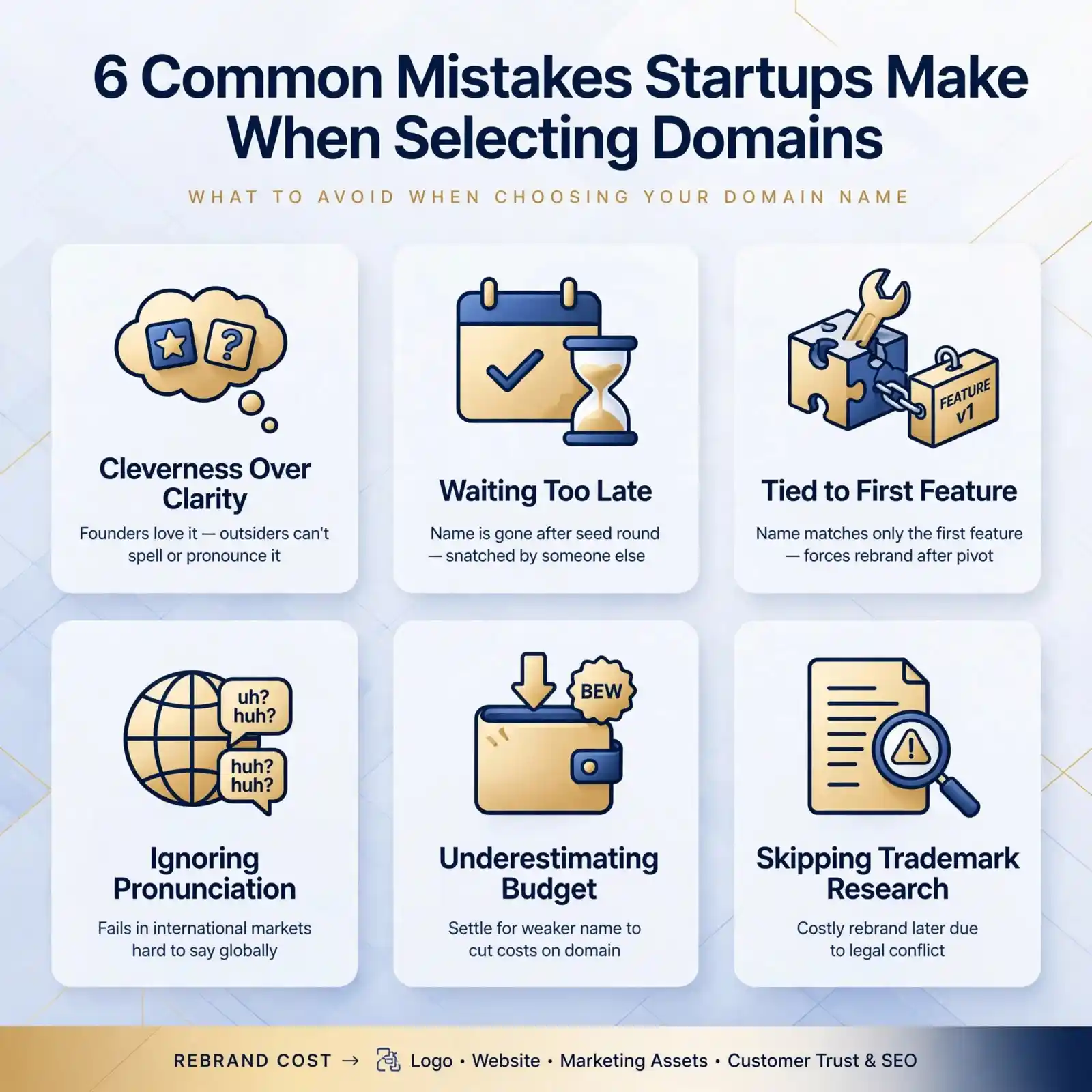
- Underestimating budget, then settling for a weaker name instead of negotiating on a strong one.
- Skipping trademark research, resulting in costly rebrands after the product has already gained traction.
Each of these mistakes is fixable early and expensive to fix late – which is precisely why domain strategy tends to work best as a pre-business-plan decision rather than a post-launch cleanup task.
The rebrand cost in particular tends to surprise founders. Beyond the price of a new domain, a mid-stage rebrand typically involves redesigning a logo, updating every marketing asset, notifying existing users, re-establishing search rankings from scratch, and often re-filing trademarks. For a startup already juggling limited runway, this combination of costs is far steeper than simply investing more carefully in the name during the pre-launch phase.
Expert Tips for Securing a Brandable Domain on a Startup Budget
Founders without a large marketing budget can still compete for strong names using a few practical tactics:
- Negotiate directly with domain owners rather than relying solely on marketplace listing prices.
- Consider newer extensions (.io, .ai, .co) when the ideal .com is unavailable, especially within tech-forward audiences already comfortable with them.
- Bundle domain and trademark budget together early, rather than treating them as separate line items.
- Move quickly once a name tests well – brandable inventory in hot categories like AI and fintech depletes fast.
- Use a broker or marketplace with escrow protection to avoid payment risk during private negotiations.
For a deeper look at negotiation tactics from the seller’s side – useful context for understanding pricing psychology – the playbook on selling a brandable domain name explains how sellers price and justify premium names, which helps buyers negotiate more realistically.
Founders working with limited seed capital often find more success by narrowing their search to marketplaces that specialize in curated, pre-vetted brandable names rather than relying purely on expired-domain auctions, which tend to surface names with weaker phonetic quality and inconsistent backlink histories. A curated marketplace also typically includes basic due diligence – trademark conflict checks, prior usage history, and clean domain records – that a first-time founder might otherwise overlook under launch-timeline pressure.
Real-World Patterns: Domain Choices by Startup Stage
| Startup Stage | Typical Domain Behavior | Primary Goal |
|---|---|---|
| Pre-seed / idea stage | Secures a brandable domain, launches waitlist page | Signal legitimacy, capture early emails |
| Seed round | Refines branding, may still adjust domain if pivoting | Align name with funded direction |
| Series A | Domain is locked, brand investment increases | Category ownership, press consistency |
| Growth stage | Domain becomes a recognized asset, rarely changes | Trust at scale, SEO compounding |
This progression shows why the earliest possible stage is also the cheapest and lowest-risk moment to lock in a strong, brandable name – waiting only raises the cost of both the domain and the eventual rebrand.
Buying vs Selling: Where Startups Fit into the Brandable Domain Market
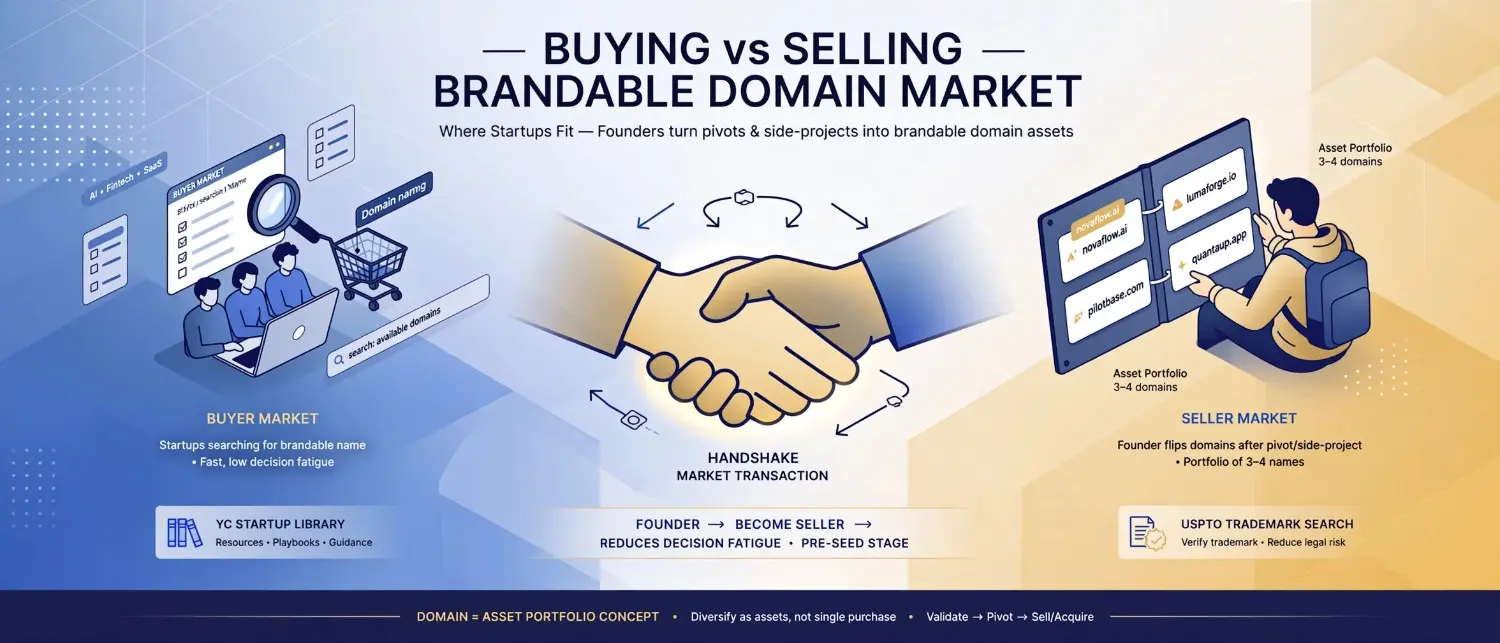
Interestingly, many startup founders eventually become domain sellers themselves – either flipping a name they no longer need after a pivot, or selling an old side-project domain once it stops being useful. Understanding both sides of the market, covered in the seller’s playbook and the first-time buyer’s guide, helps founders negotiate more confidently in either direction.
This dynamic is worth planning for even at the pre-seed stage. A founder who buys three or four candidate domains during the naming process, then commits to one, often ends up holding surplus names that can later be resold, transferred to a future project, or offered to another founder navigating the same search. Treating domains as a small, manageable asset portfolio – rather than a single, high-pressure purchase – tends to reduce decision fatigue during an already demanding pre-launch period.
For founders researching general startup naming and branding practices further, resources such as the Y Combinator startup library and the USPTO trademark search database are useful starting points before finalizing a name.
How to Know the Domain Investment Is Paying Off
Because branding value is harder to measure than a conversion rate, founders sometimes struggle to justify spending real budget on a name. A few practical signals tend to indicate a brandable domain is doing its job during the pre-launch and early-launch period:
- Unprompted recall: people mention the company by name in conversation without needing the founder to repeat it.
- Correct typing on the first attempt: low bounce rates from direct traffic suggest the name is easy to spell from memory.
- Reduced need for spelling clarification during cold outreach, demos, or investor calls.
- Organic press mentions that use the company name as the headline hook rather than a generic category description.
- Consistent social handle matches, reducing brand confusion across platforms.
None of these signals show up on a standard analytics dashboard immediately, which is why many founders track them qualitatively during the first few months – noting how often the name needs repeating in a pitch, or how quickly a new contact remembers it in a follow-up email. Over time, these small frictions (or their absence) compound into a measurable difference in referral rates and press pickup.
FAQ
What are brandable domains for tech startups?
Brandable domains for tech startups are short, ownable, invented or blended names – such as Aotiv, Notion, or Figma – chosen for memorability and flexibility rather than literal keyword description. They are built to function as a standalone brand asset that gains meaning over time, rather than one that describes a product feature from day one.
Why do brandable domains matter before a product launch?
Because a pre-launch startup often has no product history, testimonials, or press coverage to point to, the domain becomes one of the first tangible signals of credibility for users, journalists, and investors evaluating the company. A polished, considered name suggests the founders are building for the long term rather than testing a quick idea.
Are brandable domains more expensive than keyword domains?
Often yes, particularly for short, dictionary-adjacent, or invented names in competitive niches such as AI and fintech, though pricing varies widely based on length, extension, and negotiation. Founders willing to negotiate directly with domain owners, or consider slightly longer invented blends, can often secure strong names at a more moderate cost.
Should a startup buy its domain before writing a business plan?
Many founders do, since a strong brandable name can be difficult to secure later and often shapes early positioning decisions that feed directly into the business plan itself. Locking in the name early also protects against a competitor claiming the same domain during the planning phase.
Can a brandable domain survive a startup pivot?
Yes – this is one of the main advantages over keyword domains, since a name untied to a specific feature or product description doesn’t need replacing when the product direction changes. Several well-known tech companies have pivoted their core product entirely while keeping the same brandable name throughout.
Ultimately, the naming decision is one of the few pre-launch choices a founder makes that keeps paying dividends long after the product itself has changed shape several times over. Treating it with the same rigor as a first hire or an early architecture decision tends to save both money and momentum later.
Conclusion
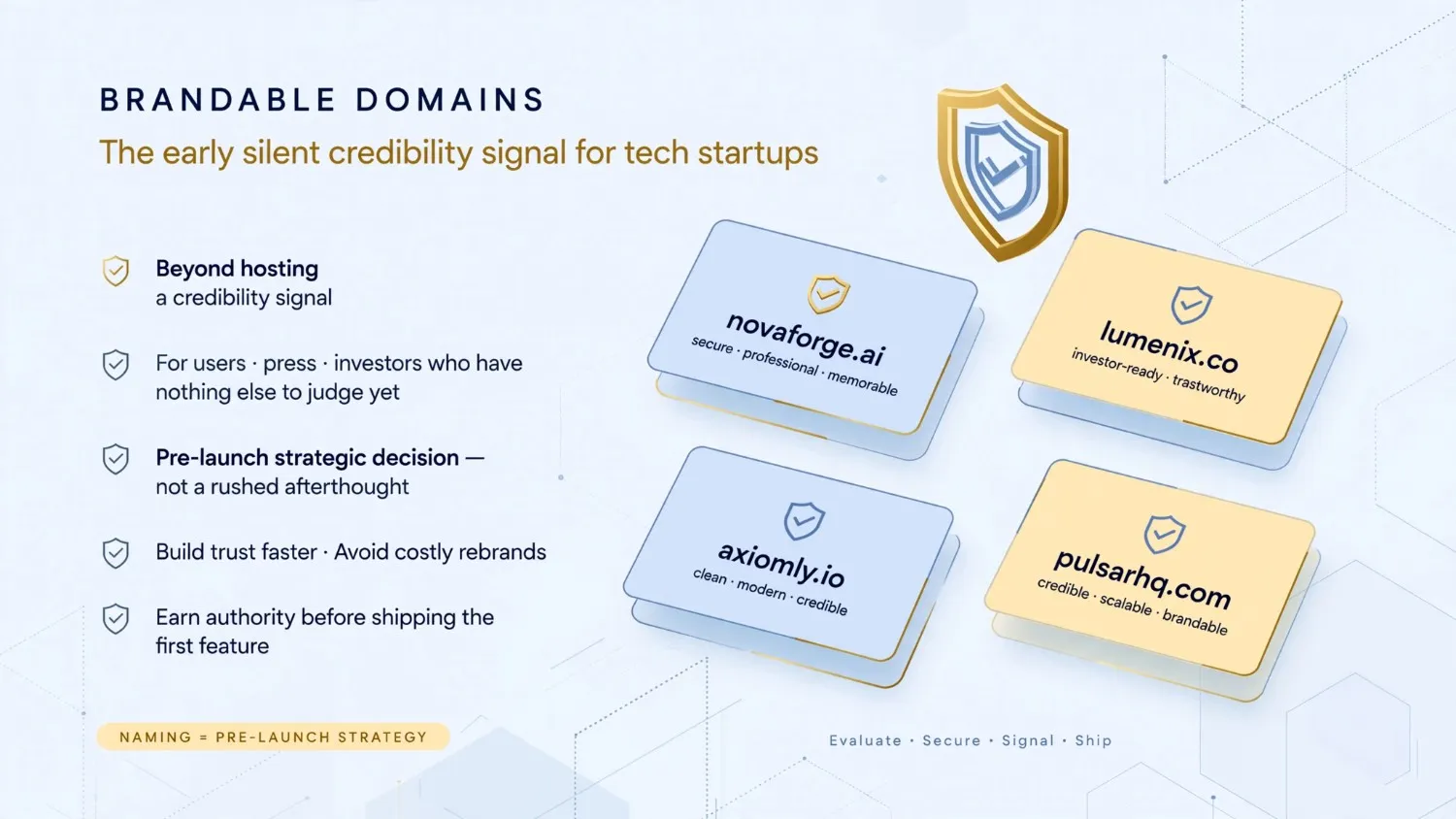
Brandable domains for tech startups do more than host a website – they act as an early, silent credibility signal for users, press, and investors who have nothing else to judge the company by yet. Founders who treat naming as a pre-launch strategic decision, rather than a rushed afterthought, tend to build trust faster and avoid costly rebrands down the line. If you’re evaluating names for your own startup, to find a name built to earn authority before you’ve shipped a single feature.
Pingback: When to Rebrand Your Domain Name: 8 Clear Signals