
Knowing how to value a domain name means weighing five measurable factors together: brandability, length, keyword relevance, extension, and comparable sales data. A domain with strong phonetic appeal, a short character count, and a proven sales history in its niche will consistently command a higher appraisal than one relying on a single strength. Domain appraisal isn’t guesswork, though the industry sometimes treats it that way. It’s a discipline built on data, pattern recognition, and an honest read of buyer psychology – and once you understand the framework professional appraisers actually use, you can apply it to any name in minutes.

Whether you’re evaluating a domain for acquisition through a platform like Aotiv, preparing to list one for sale, or simply auditing your existing portfolio, the ability to price a domain correctly is the single skill that separates profitable domain investors from everyone else. This guide breaks the entire appraisal process into a repeatable framework you can use immediately.
What Does It Mean to Value a Domain Name?
Valuing a domain name means estimating its fair market price based on measurable and subjective factors that influence how much a buyer would realistically pay for it. Unlike physical assets, a domain has no manufacturing cost, no depreciation schedule, and no standardized appraisal certification body. Its value is derived almost entirely from demand: how badly a business, brand, or investor wants that exact string of characters pointing to their website.

This makes domain valuation part data science and part branding psychology. A name might score well on every technical metric – short, pronounceable, brandable – and still be worth little if there’s no commercial category actively seeking that kind of name. Conversely, a longer or less conventional name can command a premium if it perfectly captures a fast-growing niche.
Why Domain Valuation Matters
Why Domain Valuation Matters
Getting a domain appraisal right protects both sides of a transaction by replacing assumptions with objective valuation. Whether you’re buying, selling, or investing, understanding a domain’s true market value leads to better financial decisions and reduces the risk of costly mistakes.
- Sellers avoid underpricing an asset that could have sold for significantly more with better positioning.
- Buyers avoid overpaying based on emotional attachment to a name rather than its actual market worth.
- Investors need consistent valuation logic to build a portfolio that appreciates over time rather than sitting as dead inventory.
- Startups need to justify a domain purchase as a business expense with a defensible ROI case, not a vanity decision.
Because startup naming strategy typically needs to be settled before the business plan is finalized, founders in particular benefit from a clear, defensible way to judge whether a domain is worth the asking price.

The Core Framework: Key Factors That Determine a Domain’s Value
Professional appraisers rarely rely on a single metric. Instead, they weigh several factors together, adjusting the emphasis based on the domain’s category. Here is the complete list used throughout the industry.
1. Length and Memorability

Shorter domains are consistently valued higher because they’re easier to type, recall, and speak aloud. As a general rule:
- 3-6 characters: premium tier, often reserved for established brands or heavily negotiated deals
- 7-12 characters: the most active trading range for brandable names
- 13+ characters: value drops sharply unless the name is a recognizable phrase or strong keyword match
2. Brandability and Phonetic Appeal

A brandable domain earns its value from how it sounds and feels, not from literal keyword matching. Names built on strong phonetic patterns – clear vowel sounds, easy syllable breaks, no awkward letter clusters – test better with consumers and are remembered after a single exposure. This is precisely why the science of how phonetics shapes brand perception has become a core part of modern domain appraisal rather than an afterthought.
3. Keyword Relevance vs. Brandable Value

Keyword domains derive value from direct search intent (think a domain that literally contains a product category), while brandable domains derive value from distinctiveness and trademarkability. Appraisers weigh these differently:
- Keyword domains are valued on estimated search volume, commercial intent, and exact-match SEO benefit.
- Brandable domains are valued on uniqueness, pronounceability, and cross-industry flexibility.
Because these two categories are appraised through almost opposite lenses, it helps to understand the practical differences between brandable and keyword domains before applying a single valuation method to both.
4. Extension (TLD)

The extension still matters enormously to buyers, even as consumer familiarity with newer TLDs grows:
- .com remains the default trust signal and typically carries the highest resale value across nearly every category.
- .io, .ai, .co hold strong secondary value in tech and startup circles.
- Country-code TLDs (.us, .uk, .in) can command a premium within their specific geographic market.
- Newer gTLDs (.xyz, .store, .app) trade at a fraction of equivalent .com value unless tied to a niche where the extension itself is meaningful.
5. Market Comparables and Sales History

Just like real estate appraisal, domain valuation leans heavily on recent comparable sales. Appraisers look at:
- Publicly reported sales of similar-length, similar-category domains
- Aftermarket auction results
- Private sale data where available through brokerage platforms
6. Existing SEO Value and Traffic

A domain that already has organic traffic, backlinks, or search rankings carries additional value beyond its name alone. This applies mainly to previously used or expired domains rather than freshly registered ones, and appraisers typically verify:
- Backlink profile quality (not just quantity)
- Historical use (was it ever used for spam or thin content?)
- Existing organic traffic and its relevance to the buyer’s industry
7. Trademark and Legal Clearance

A domain that infringes on an existing registered trademark carries legal risk that suppresses its resale value regardless of how strong it sounds. Before finalizing any appraisal, a quick trademark search through an official register such as the USPTO’s Trademark Electronic Search System is standard due diligence for serious buyers and sellers alike.
8. Industry and Niche Demand

The same name can be worth vastly different amounts depending on which industry is actively buying. A name that sounds perfect for a fintech startup might be nearly worthless in an unrelated category, so appraisers always contextualize a domain against current buyer demand in its most relevant niche.
Step-by-Step: How to Value a Domain Name
Here’s the practical process for applying the framework above to any domain you’re evaluating:
Step 1: Confirm the exact domain string and extension.
Note character count, hyphens, and numerals, since each reduces value differently.
Step 2: Score brandability independently of keyword relevance.
Read the name aloud, say it in a sentence like “check out [name].com,” and note whether it feels natural.
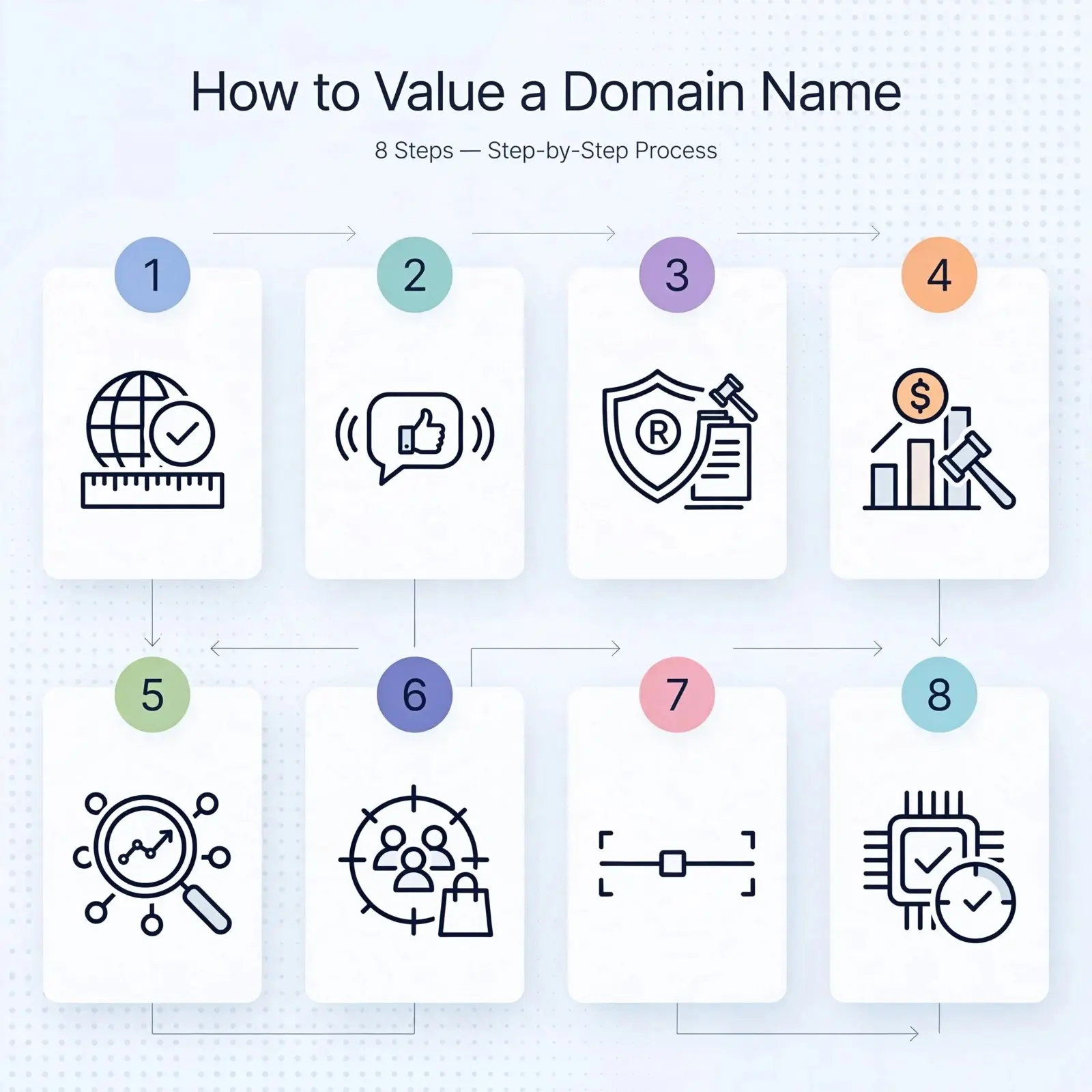
Step 3: Do a Trademark Search
Run a trademark check against official registers to rule out legal conflicts before pricing continues.
Step 4: Pull comparable sales
Pull comparable sales for domains of similar length, style, and category from recent marketplace or auction data.
Step 5: Checking existing SEO authority if any
Check for existing SEO equity using backlink and traffic history tools if the domain isn’t newly registered.
Step 6: Buy from the relevant market place
Identify the most relevant buyer industry and weigh demand within that specific niche rather than the general market.
Step 7: Combine the factors into a price range
Combine the factors into a price range, not a single number – domain value is rarely precise to the dollar, and a defensible range gives both parties room to negotiate.
Step 8: Cross-check the range against an algorithmic estimator
Cross-check the range against an algorithmic estimator as a sanity check, understanding its limitations rather than treating it as final.
Domain Valuation Tools and Methods
| Method | Best For | Limitation |
|---|---|---|
| Manual comparable analysis | Brandable and premium domains | Time-intensive, requires market knowledge |
| Algorithmic estimators (e.g., automated appraisal tools) | Quick ballpark figures | Frequently misjudges brandable value and phonetic appeal |
| Professional broker appraisal | High-value transactions, disputes | Costs a fee, takes longer to turn around |
| Auction and marketplace history review | Keyword and category-specific domains | Data can be sparse for unusual or new categories |
Brandable vs. Keyword Domain Valuation: A Comparison
| Factor | Brandable Domain | Keyword Domain |
|---|---|---|
| Primary value driver | Sound, memorability, distinctiveness | Search volume, exact-match relevance |
| Ideal length | Typically 5-9 characters | Can be longer if it matches a full search phrase |
| SEO benefit | Indirect, through brand recognition | Direct, through keyword matching |
| Trademark risk | Lower if name is invented/unique | Higher if it overlaps with an existing product category |
| Buyer pool | Startups, agencies, rebrands | Niche businesses, affiliate sites, local services |
Common Mistakes When Valuing a Domain Name
Mistake 1: Anchoring to the original registration cost.
What you paid years ago has no bearing on current market demand.
Mistake 2: Relying solely on automated appraisal scores.
These tools are useful for a rough starting point but consistently undervalue strong brandable names and overvalue generic keyword strings.
Mistake 3: Ignoring extension-specific comparables.
Comparing a .com sale price directly to a .io or .co listing skews the estimate.

Mistake 4: Skipping the trademark check.
A name that sounds perfect can become a liability if it infringes on protected intellectual property.
Mistake 5: Valuing in isolation from buyer intent.
A domain’s worth changes depending on whether the audience is an enterprise brand, a solo founder, or an SEO-driven affiliate site.
Expert Tips for a More Accurate Appraisal
- Say the domain out loud in a real sentence before assigning a number – names that stumble verbally rarely hold their appraised value at resale.
- Weight recent sales more heavily than older comparables, since buyer appetite for categories shifts within months, not years.
- Treat every valuation as a range with a floor and ceiling rather than a single fixed price, and be transparent about which factors pushed the estimate toward either end.
- Revisit valuations periodically. A name that seemed average two years ago can appreciate significantly if its associated industry experiences rapid growth.

How Startups Approach Domain Valuation
Founders often need to justify a domain purchase to co-founders or investors, which means the valuation has to hold up under scrutiny. This is one reason tech startups increasingly treat a brandable domain as an authority signal rather than a cosmetic detail – the appraisal effectively becomes part of the pitch for why the domain investment makes business sense.
When to Get a Professional Appraisal
Self-assessment using the framework above is sufficient for most transactions under a few thousand dollars. However, a professional broker appraisal is worth the fee when:
- The domain is likely to sell in the five-figure range or higher
- The transaction involves a dispute or legal proceeding
- You need a formal, documented valuation for accounting, insurance, or tax purposes
- You’re negotiating a portfolio sale involving dozens of domains at once
Applying Valuation Knowledge: Buying and Selling Context
Valuation skill only matters once you act on it. If you’re on the acquisition side, a solid appraisal protects you from overpaying – our guide for first-time domain buyers walks through the negotiation process in detail. If you’re preparing to sell, the same valuation framework becomes your pricing justification – covered step by step in our complete seller’s playbook for brandable domains.
For a foundational refresher on what separates a brandable domain from every other type of name in the market, our complete guide to brandable domains is a useful starting point before you appraise your first portfolio.
For a broader industry view of pricing trends, Verisign’s quarterly Domain Name Industry Brief offers registration and market data that can help contextualize where demand is shifting across extensions.
Frequently Asked Questions
How do I know how to value a domain name without hiring an appraiser?
Apply the core framework: assess length, brandability, keyword relevance, extension, comparable sales, and existing SEO value, then combine these into a defensible price range rather than a single number.
What is the single most important factor in domain valuation?
There isn’t one universal factor – brandable domains lean on phonetics and memorability, while keyword domains lean on search volume and commercial intent. The right weighting depends on the domain’s category.
Are automated domain appraisal tools accurate?
They’re useful for a fast ballpark estimate but frequently misjudge brandable value, since algorithms struggle to score subjective qualities like phonetic appeal or emotional resonance the way a human buyer would.
Does a longer domain always mean lower value?
Generally yes, but exceptions exist. A longer domain that exactly matches a high-intent search phrase can outperform a shorter, less relevant one within its specific niche.
Should I check trademarks before valuing a domain name?
Yes. A trademark conflict introduces legal risk that suppresses value regardless of how strong the name sounds, so this check belongs early in the appraisal process, not after a price has already been set.
How often should I revalue domains in my portfolio?
Every six to twelve months is a reasonable cadence, since buyer demand within a given industry can shift meaningfully within that window.
Conclusion
Learning how to value a domain name accurately comes down to applying the same factors professional appraisers use every day: length, brandability, keyword relevance, extension, comparable sales, SEO equity, legal clearance, and niche demand. Treat every appraisal as a range grounded in current market data rather than a guess based on gut feeling, and you’ll price domains – whether buying, selling, or holding – with real confidence.

Ready to put this framework into practice? and find a name that’s already positioned to appreciate.
Pingback: When to Rebrand Your Domain Name: 8 Clear Signals