
AI domain name generation uses natural language models and linguistic pattern-matching to produce large volumes of available domain candidates in seconds, dramatically compressing the brainstorming phase of brand naming. It cannot, however, replicate trademark judgment, cultural nuance, emotional resonance, or the strategic positioning work that separates a forgettable string of letters from a name investors, customers, and search engines actually trust. The technology is a brainstorming accelerant, not a replacement for naming expertise.
Choosing a company name used to mean whiteboard sessions, thesaurus tabs, and a founder muttering syllables out loud until something clicked. Today, a founder can type a two-line prompt into an AI domain name generator and receive fifty options before their coffee cools. That shift has real value – and real limits. Understanding what is a brandable domain matters more than ever now that AI tools are flooding founders with volume over judgment, because speed without discernment produces names that are available, pronounceable, and completely forgettable.


This guide breaks down exactly where AI domain name generation earns its place in a modern naming workflow, where it consistently fails, and how the two smartest approaches – algorithmic speed and human strategic judgment – work best when combined rather than treated as competitors.
What is AI Domain Name Generation?
AI domain name generation is the use of machine learning models, typically large language models (LLMs) or rule-based linguistic algorithms, to produce candidate domain names based on a set of inputs such as industry, tone, target keywords, or brand adjectives. Most tools then cross-reference the output against live domain registries to filter for availability in real time.
In simple terms: you describe your business, the AI produces a list, and a separate lookup layer tells you which names are actually purchasable.

Quick definition for reference:
AI domain name generation is an automated process that combines natural language pattern recognition with domain availability checks to rapidly produce brandable or keyword-based name candidates for a business or website.
The Three Core Components of Any AI Naming Tool
- Input parsing – the model interprets your prompt (industry, keywords, style preferences).
- Pattern generation – it produces name variants using techniques like blending, affixing, phonetic substitution, or compounding.
- Availability filtering – a secondary system checks each candidate against WHOIS or registrar databases and discards taken domains.
Every mainstream naming tool, from simple keyword combiners to GPT-powered generators, runs some version of this three-step loop.
How AI Domain Name Generators Actually Work Under the Hood
Most people assume these tools “understand” branding the way a strategist does. They don’t. Here’s what’s actually happening technically:
- Token prediction, not brand strategy. LLM-based generators predict statistically likely next characters or syllables based on training data, not on your competitive landscape.
- Linguistic templates. Many tools rely on templates – prefix + root word, root word + suffix, or two blended roots – which is why AI-generated lists often feel repetitive after the first ten results.
- Popularity bias. Because these models are trained on existing successful brand names, they gravitate toward already-common patterns (adding “-ly,” “-io,” “get-,” or “-hub”), which increases the odds of trademark collision.
- No context about your actual audience. The AI does not know your customer’s psychographics, your investor narrative, or how the name will sound said aloud on a sales call – it only knows the words you typed into the prompt box.
This matters because it explains both the strength and the ceiling of the technology in the same breath.
What AI Can Genuinely Do Well

Give credit where it’s due – AI domain name generation solves a real, painful bottleneck in the naming process: idea volume.
- Speed at scale. Generating 100+ candidate names manually might take a skilled namer several hours; AI does it in under a minute.
- Instant availability filtering. No more falling in love with a name only to discover it was registered in 2019.
- Pattern exploration. AI is genuinely useful for surfacing blend combinations (like portmanteaus) a human might not think to try.
- Removing blank-page anxiety. For founders who freeze at an empty naming document, a generated list gives something concrete to react to, even if the reaction is “none of these work.”
- Budget accessibility. Early-stage founders without funds for a naming agency get a usable starting point for free or near-free.
Used correctly, AI domain name generation functions as a first-draft machine – useful precisely because it is fast and disposable, not because its output is final.
Where AI Domain Name Generation Falls Short
This is the part most “AI will replace branding” articles skip. Here is where the technology consistently underperforms compared to an experienced human namer or naming strategist.
1. Trademark and Legal Risk Assessment

AI tools check domain availability, not trademark conflict. A name can be unregistered as a .com and still infringe on an existing trademark in your industry class, exposing a new business to a costly rebrand or legal dispute later. The USPTO trademark basics guide makes clear that a comprehensive clearance search – covering registered marks, common law use, and international filings – is a distinct, specialized process that no domain generator performs.
2. Phonetic and Cultural Nuance

AI models are trained overwhelmingly on English-language, Western-market data. They routinely produce names that:
- Are difficult to pronounce across accents
- Carry unintended meanings in other languages
- Fail basic sound-symbolism principles that shape how a word “feels” (soft vs. hard consonants, vowel length, syllable rhythm)
Understanding how phonetics shape brand perception is a discipline built on decades of linguistic and psychological research – something no autocomplete-style tool currently models with any reliability.
3. Emotional Resonance and Story

A name is often the first sentence of a brand’s story. Human namers ask: What does this word evoke? What memory or feeling does it borrow from? AI does not evaluate emotional weight – it evaluates statistical plausibility. That’s why so many AI-generated names sound structurally fine but emotionally flat.
4. Strategic Positioning

A name should reinforce market position – premium versus accessible, technical versus consumer-friendly, global versus local. AI has no awareness of your competitive set unless you spell it out in exhaustive detail, and even then it cannot weigh trade-offs the way a strategist reviewing your actual pitch deck can.
5. Long-Term Brand Scalability

Will the name still make sense if the company pivots products in three years? Does it box the brand into one narrow category? These are judgment calls rooted in business foresight, not pattern generation.
6. Domain Valuation and Investment Logic

If you’re evaluating a name as a long-term brand asset rather than a throwaway, you need to understand why certain domains hold and appreciate in value. A generator has no concept of this. Working through how to value a domain name using a complete appraisal framework reveals variables like extension, length, memorability, and search volume history that purely generative tools never factor into their output.
A Brief History: How Domain Naming Worked Before AI
Before AI domain name generation existed, naming a company followed a slower, more manual path. Founders and agencies relied on:
- Thesaurus and etymology deep-dives, manually hunting for root words in Latin, Greek, or other languages that carried the right connotation.
- Whiteboard brainstorming sessions, often lasting days, where teams generated hundreds of options by hand.
- Manual WHOIS lookups, checking one domain at a time to see if it was registered – a process that could take hours for a single shortlist.
- Paid naming agencies, which could charge tens of thousands of dollars for a full naming engagement, including trademark screening and market testing.
This history matters because it explains why AI domain name generation felt so revolutionary when it first became mainstream: it collapsed a process that used to take days into something that takes minutes. But it’s worth remembering that the manual process wasn’t slow because humans were inefficient – it was slow because trademark research, linguistic testing, and strategic alignment genuinely take time to do well. AI compressed the fast parts of naming; it didn’t eliminate the parts that were slow because they mattered.
Industry-Specific Considerations for AI-Generated Domain Names
Not every industry can treat AI domain name generation the same way. The acceptable risk level – and the depth of human review required – shifts significantly by sector.
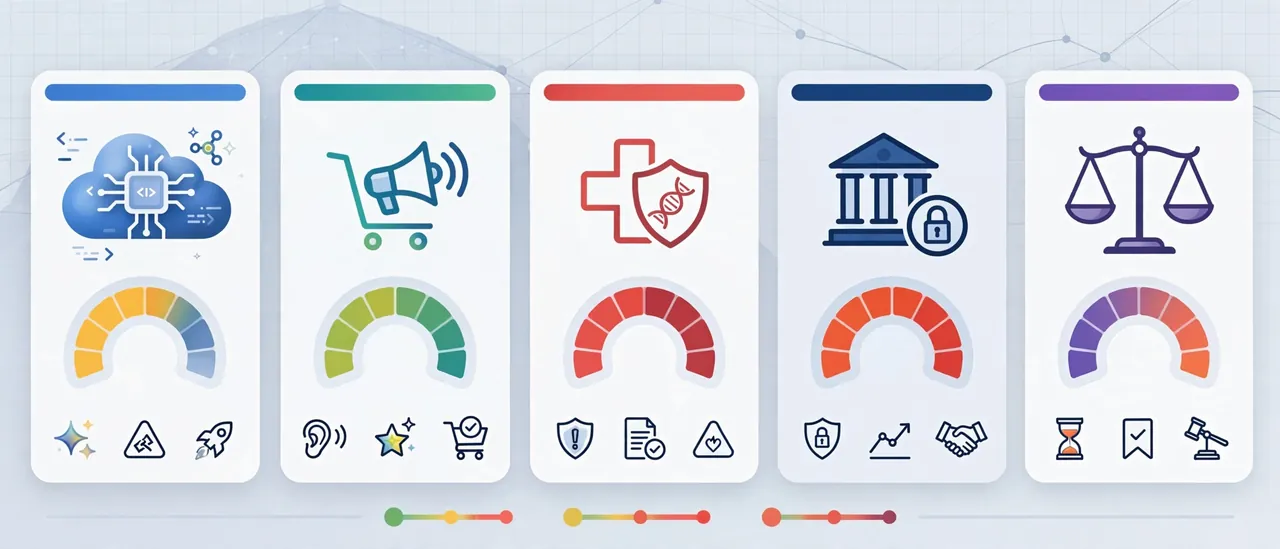
SaaS and Tech Startups
Tech naming culture already favors short, invented, or blended words, which plays directly into AI’s strengths. Still, the SaaS space is crowded and trademark collisions are common, so even a “quick” AI-suggested name needs a clearance search before it appears on a pitch deck.
E-Commerce Brands
E-commerce names benefit from memorability and easy verbal sharing (“just search for…”). AI-generated names here should be tested specifically for how they perform in spoken word-of-mouth and paid ad copy, not just how they look written down.
Healthcare and Medical Brands
This is one of the highest-risk categories for unreviewed AI output. Names in healthcare face strict regulatory scrutiny, and a word that sounds neutral in casual English can carry clinical, alarming, or even offensive connotations once translated or interpreted by a medical audience. Human review here isn’t optional – it’s a compliance consideration.
Fintech and Financial Services
Financial brands need names that convey trust and stability, a quality that’s difficult for AI to optimize for since “trustworthy-sounding” is subjective and culturally dependent. Additionally, financial services trademarks are aggressively defended, making legal clearance especially critical.
Legal and Professional Services
Firms in this category often need names that signal credibility and longevity rather than novelty. AI tools, which are statistically biased toward trendy blends and short invented words, frequently underperform here compared to a human namer who understands the conservative naming conventions of the sector.
How to Prompt an AI Domain Name Generator for Better Output
If you’re going to use AI domain name generation as your starting point, the quality of your prompt determines the quality of your raw list. A few practical techniques:
- Be specific about tone, not just industry. “Playful fintech app for Gen Z” produces very different output than “fintech app.”
- Include words to avoid, not just words to include – most tools respond well to negative constraints.
- Ask for name types separately. Request compound words, invented blends, and metaphor-based names in distinct prompts rather than one mixed batch; this produces more usable variety.
- Iterate in small batches. Generating 20 names, reviewing them, then refining your prompt based on what worked tends to outperform one giant 200-name dump.
- Always cross-check the “available” flag manually before falling in love with any option – availability data in some tools lags behind live registry changes by hours or even days.
AI-Generated Names vs. Human-Crafted Names: A Direct Comparison
| Factor | AI Domain Name Generation | Human Naming Process |
|---|---|---|
| Speed | Seconds to minutes for 50+ options | Hours to weeks for a refined shortlist |
| Trademark risk screening | Not performed | Central to the process |
| Cultural/linguistic nuance | Limited, English-biased | Deep, context-aware |
| Emotional resonance | Not evaluated | Core evaluation criterion |
| Cost | Free to low-cost | Ranges from low (DIY) to high (agency) |
| Strategic brand alignment | Requires manual filtering after generation | Built into the process from the start |
| Long-term scalability check | Not assessed | Explicitly assessed |
| Best use case | Idea volume, first drafts | Final selection, brand-critical decisions |
The pattern is consistent: AI wins on speed and volume; humans win on judgment and risk mitigation. Neither column replaces the other – they’re sequential stages, not competitors.
Common Mistakes Founders Make When Relying Solely on AI Tools

- Registering the first available option without a trademark search, discovering a conflict only after building brand equity.
- Choosing a name purely because it “sounds techy,” without checking whether it fits the actual product category or when it might later force a rebrand.
- Ignoring pronunciation testing. A name that reads fine on screen can fail completely when said out loud in a pitch meeting or podcast interview.
- Overvaluing novelty over memorability. AI often produces unusual blends that feel “unique” but are genuinely hard for customers to recall or spell correctly.
- Skipping competitive-set comparison, ending up with a name that sounds nearly identical to an existing player in the same market.
- Treating the AI list as the finish line rather than the starting line of the naming process.
Expert Tips for Blending AI Speed With Human Judgment
- Use AI for volume, not verdicts. Generate broadly, then apply human filters – never launch straight from an unreviewed AI list.
- Run every finalist through a trademark screening tool before getting emotionally attached to it.
- Say every shortlisted name out loud, to multiple people, in different contexts (phone intro, elevator pitch, casual conversation).
- Check the domain’s history, not just current availability – some AI-suggested “available” domains were previously used for spam or carry negative SEO baggage.
- Compare shortlisted names against your top three competitors’ domains side by side for differentiation.
- Bring in outside perspective. Founders are often too close to their own idea to judge a name objectively; a second set of eyes catches issues AI and solo brainstorming both miss.
- If evaluating a premium acquisition rather than a fresh registration, study how tech startups use brandable domains to establish authority before finalizing a budget.
A Practical Hybrid Naming Workflow (Step by Step)
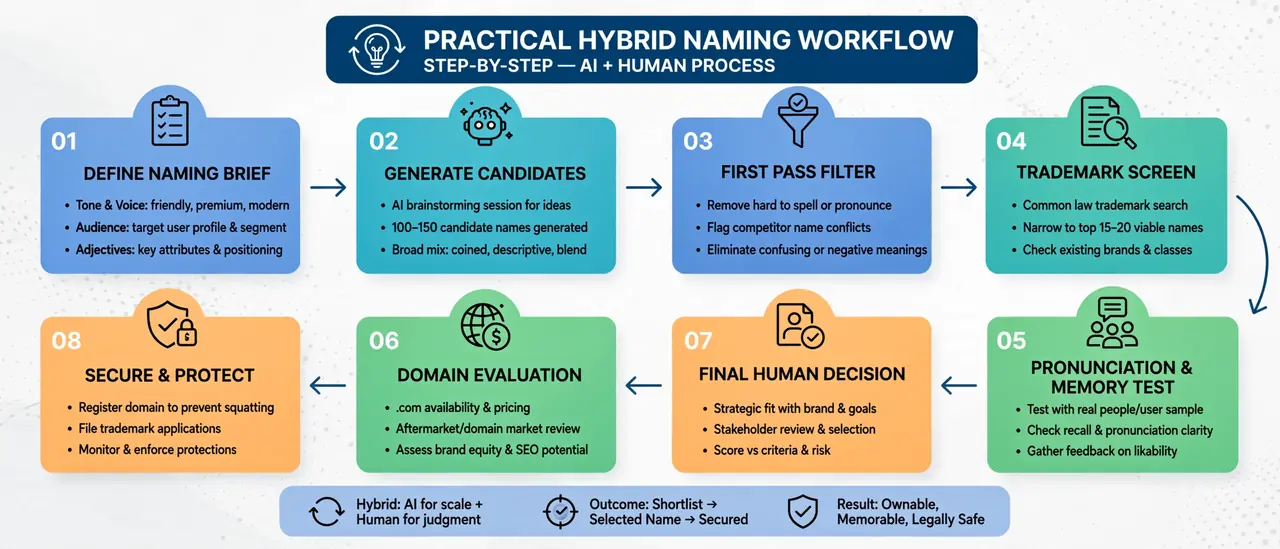
- Define your naming brief. Write down tone, target audience, category, and three adjectives the brand should evoke.
- Generate broadly with AI tools. Aim for 100-150 raw candidates across multiple prompts and phrasing variations.
- Apply a first-pass filter. Eliminate anything hard to spell, pronounce, or that duplicates a known competitor.
- Run a trademark and common-law search on your top 15-20 survivors.
- Pronunciation and memory test the remaining list with at least five people outside your company.
- Evaluate domain quality and pricing. Compare .com availability, aftermarket pricing if the primary is taken, and long-term brand equity potential.
- Make the final call as a human decision, weighing strategic fit over algorithmic novelty.
- Secure the domain and begin brand-building immediately to prevent squatting or competitive registration.
This structured approach treats AI exactly as it should be treated: a powerful first-stage tool inside a process that still requires human ownership at every decision point.
Where AI-Generated Names Genuinely Work Well vs. Where They Don’t
| Use Case | AI-Generated Names Suitable? | Why |
|---|---|---|
| Early brainstorming sessions | Yes | High-volume idea generation is the tool’s core strength |
| Side projects and MVPs | Yes, with light screening | Lower stakes, faster iteration acceptable |
| Venture-backed startup branding | With caution | Requires trademark and strategic review before finalizing |
| Legacy business rebrand | Not recommended alone | Existing brand equity and reputation require nuanced judgment |
| International or multi-market brand | Not recommended alone | Cultural and linguistic review is essential |
| Domain investment/resale asset | Not recommended alone | Requires valuation expertise beyond pattern generation |
Signals That a Name Needs Deeper Human Review Before Registration
Not every AI-generated candidate needs the same level of scrutiny. Use these signals to decide when to slow down and bring in human judgment before locking in a name:
- The name is unusually short or trendy. Ultra-short, invented names are more likely to already be trademarked in an unrelated category, increasing collision risk.
- The business operates in a regulated industry. Healthcare, finance, and legal services all carry higher naming stakes than a consumer hobby app.
- The company plans to raise venture funding. Investors and their legal counsel will run their own trademark diligence – catching issues yourself first avoids delays during a raise.
- The brand will operate internationally. Any name intended for multiple markets needs a linguistic and cultural check beyond what an English-trained AI model can provide.
- The name will anchor significant marketing spend. The more budget riding on brand recall, the more a flat or forgettable AI-generated name actually costs the business over time.
If two or more of these signals apply, treat the AI list as a starting point only, and budget real time – or a naming professional’s input – for the final decision.
Buying vs. Building: When to Skip Generation Entirely
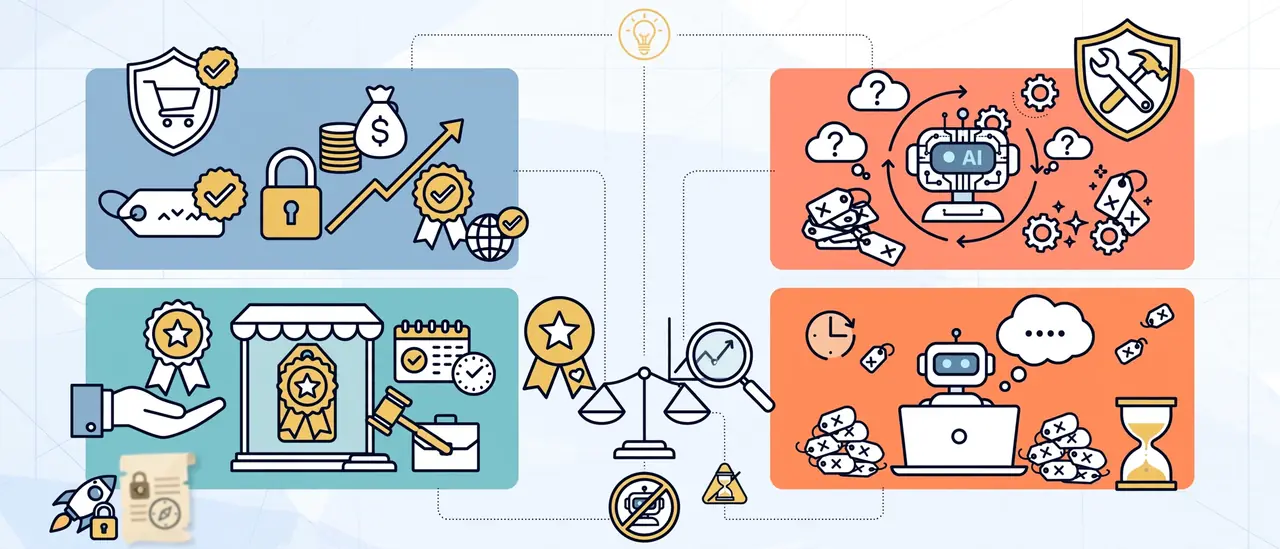
Sometimes the smartest move isn’t generating a new name at all – it’s acquiring one that’s already been crafted, vetted, and holds inherent brand value. If your naming brief keeps producing AI output that feels close but not quite right, it may be faster and more strategic to explore the aftermarket. A well-researched purchase, guided by how to buy a brandable domain name as a first-time buyer, often outperforms weeks of additional AI prompting, particularly when a startup’s naming strategy needs to be locked in before the business plan itself.
And if you’re deciding between a constructed brandable name and a descriptive keyword domain, it helps to understand the difference between brandable and keyword domains before your AI-generated shortlist even leaves the drafting stage – the two serve very different SEO and brand-equity purposes.
Frequently Asked Questions
Can AI domain name generation replace a professional brand naming agency?
No. AI domain name generation is effective for producing a high volume of raw candidates quickly, but it cannot perform trademark clearance, cultural nuance testing, or strategic brand positioning – all core services a professional naming agency provides.
Is AI-generated domain name output reliable for checking trademark conflicts?
No. Most AI naming tools only check domain registry availability, not trademark databases. A separate, dedicated trademark search through resources like the USPTO’s official trademark search system is required before committing to any name.
What’s the biggest risk of relying only on an AI domain name generator?
The biggest risk is selecting a name that is technically available but strategically weak – one that’s hard to pronounce, easily confused with a competitor, or carries unintended meaning in other markets, since AI tools don’t evaluate these human-centered factors.
Are AI-generated brand names good for startups with limited budgets?
Yes, as a starting point. AI domain name generation is a low-cost way to produce initial options, but budget-conscious founders should still allocate time (even without hiring an agency) for manual trademark checks and pronunciation testing before finalizing a name.
How many names should I generate with AI before narrowing my list?
Most naming professionals recommend generating 100-150 raw candidates through AI tools, then narrowing to a shortlist of 10-15 for deeper human evaluation, and finally to 2-3 finalists for trademark and market testing.
Does Google’s algorithm treat AI-suggested domain names differently in search rankings?
Not directly. Google does not penalize or favor a domain simply because it was AI-generated. What matters for search performance is the overall content quality, site authority, and user experience built on that domain – not how the name itself was created.
Conclusion

AI domain name generation has permanently changed the earliest stage of brand naming, turning a once-tedious brainstorm into a near-instant list of options. But speed was never the hard part of naming a company – judgment was, and still is. Trademark risk, phonetic nuance, emotional resonance, and long-term brand scalability all require human strategic thinking that current AI models simply aren’t built to provide. The smartest founders aren’t choosing between AI and human expertise; they’re sequencing them, using AI to widen the funnel and human judgment to narrow it to a name that can actually carry a company for the next decade. If your AI-generated shortlist still feels like it’s missing that final layer of strategic polish, explore Aotiv’s curated brandable domain marketplace to find a name that’s already been vetted for exactly the qualities algorithms consistently miss.