
Domain name brand consistency means your web address matches your business name, visual identity, and verbal tone across every touchpoint your audience encounters. When your domain contradicts your logo, your messaging, or your product name, every downstream branding effort – from social handles to email signatures – inherits that mismatch. A brand consistency system only holds together when the domain sits at its center, not as an afterthought bolted on after launch.


Founders often spend months refining a logo, a color palette, and a tone-of-voice guide, then register whatever domain happens to be available. That sequencing gets the priority backwards. A curated brandable domain marketplace exists precisely because the domain is not a technical detail – it is the anchor point every other brand asset gets measured against.
This guide walks through what domain name brand consistency actually means, why it functions as the foundation of your entire identity system, and how to audit, fix, or future-proof your domain choice so it stops working against your brand instead of for it.
What is Domain Name Brand Consistency?

Domain name brand consistency is the practice of ensuring your web address reflects the same name, spelling, tone, and positioning as every other customer-facing element of your business. It covers three layers:
- Nominal consistency – the domain uses your actual business name, not an abbreviation, a keyword stuffed version, or a modifier like “get” or “try” tacked on to secure availability.
- Phonetic and visual consistency – the domain sounds and reads the way your brand voice sounds, matching the register of your logo type and marketing copy.
- Structural consistency – the domain’s extension, capitalization convention, and word structure align with how the brand is written everywhere else, from business cards to app store listings.
When these three layers align, customers experience one continuous brand rather than a patchwork of near-matches they have to mentally reconcile. That reconciliation cost – however small it feels in a single interaction – compounds across every touchpoint a customer has with your business.
Why the Domain Name Sits at the Foundation of Brand Consistency
A brand consistency system typically includes a style guide, a logo suite, a tone-of-voice document, and channel-specific templates. All of those assets sit downstream of one decision: what the business is actually called online. Here is why that decision carries so much structural weight.
It Is the First Asset Customers Type, Search, or Click
Before a customer sees your logo or reads your homepage copy, they type, search, or click your domain. Search engines, email clients, and browsers all surface the raw domain string before any visual branding loads. If that string does not match the name on your storefront sign or your product packaging, the very first impression already contains a discrepancy.

Every Other Brand Asset References It
Business cards, email signatures, social bios, app store listings, and press mentions all point back to the domain. A rendering studio doing how tech startups use brandable domains to establish authority research consistently finds that companies with domain-name mismatches spend extra design and copywriting hours explaining the gap, rather than reinforcing recall.
It Cannot Be Quietly Redesigned Later
A logo can be refreshed with a blog post announcement. A tagline can shift without much friction. A domain change, however, touches SEO equity, backlinks, email deliverability, and years of brand recognition simultaneously. That is precisely why why startup name and domain strategy should come before your business plan is not just a catchy framing – it reflects how expensive it becomes to correct this decision after the fact.
The Anatomy of a Brand Consistency System
A functioning brand consistency system is not a single document; it is a set of interlocking layers that all reference the domain as their anchor. The table below breaks down how each layer depends on domain name brand consistency.
| Brand System Layer | What It Controls | How the Domain Anchors It |
|---|---|---|
| Verbal identity | Business name, tagline, tone of voice | Domain should use the exact business name, not a truncated variant |
| Visual identity | Logo, color palette, typography | Domain length and word breaks influence logo lockup and favicon legibility |
| Digital presence | Website, email, social handles | Domain determines available social handles and email address format |
| Legal identity | Trademark, incorporation name | Domain mismatches with legal name create trademark search complications |
| Customer memory | Recall, word-of-mouth, search behavior | A domain that matches spoken brand name reduces “which spelling?” search friction |
Each row in this table represents a place where inconsistency compounds. A mismatch at the domain layer does not stay contained – it ripples into legal filings, social availability, and even how easily customers can recommend you by word of mouth.
How a Mismatched Domain Undermines Every Other Brand Asset

Consider a business named “Solstice Analytics” that, for availability reasons, ends up on solsticedata.io instead of solsticeanalytics.com or a close brandable equivalent. On paper, the difference looks minor. In practice, it creates several compounding problems.
- Search confusion: Customers searching the spoken business name may land on competitor results before reaching the correct site, since the domain does not contain the expected keyword.
- Trust erosion: A domain that reads as “close but not quite” the business name triggers a subconscious credibility check, particularly for B2B buyers verifying a vendor before a purchase decision.
- Wasted marketing spend: Paid campaigns, printed collateral, and verbal mentions (podcasts, conference talks) all have to over-explain the domain, spending attention that should go toward the offer itself.
- Fragmented social proof: Reviews, mentions, and backlinks split between the “expected” name and the actual domain, diluting authority signals that would otherwise consolidate.
None of these problems are catastrophic individually. Together, they quietly tax every subsequent marketing effort, which is exactly why domain name brand consistency belongs at the start of brand planning rather than the end.
Domain Name and Visual Identity Alignment

Visual identity is not limited to color and typography – it also includes how a name behaves as a written object. A domain name shapes visual identity in ways many founders overlook until a designer flags them.
Short, phonetically clean domains produce cleaner favicons, app icons, and logo lockups, since designers have fewer characters to compress into a small visual footprint. Longer or hyphenated domains often force awkward abbreviations in tight spaces like mobile navigation bars or social avatars, breaking the consistency a style guide is supposed to protect.
Understanding how phonetics shape brand perception through sound-to-meaning science helps explain why certain domains simply feel more premium or more trustworthy before a customer reads a single word of copy. That phonetic quality, once locked into a domain, becomes the baseline every logo and tagline has to live up to.
Domain Name and Verbal Identity Alignment
Verbal identity covers your tone, your tagline, and the words your team uses in sales calls and support tickets. A domain name that contradicts this tone creates friction every time it is spoken aloud.

A playful, consumer-facing brand with a stiff, hyphenated, keyword-stuffed domain sends mixed signals before the homepage even loads. Conversely, a serious B2B service brand with a domain that reads as a casual nickname can undercut the authority the sales team is trying to project on calls.
Consistency here is not about picking the “correct” tone; it is about making sure the domain and the verbal identity documents describe the same brand personality. This is one of the most common gaps a brandable domain marketplace comparison to choose the right platform is designed to help founders avoid, since different marketplaces skew toward different naming styles.
Domain Name Consistency Across Every Channel
Domain name brand consistency is not confined to the website. It cascades into nearly every channel a business operates on:
- Email – Professional email addresses (name@yourdomain.com) reinforce the domain every time a customer receives a message; a mismatched email provider undercuts this instantly.
- Social media – Handle availability is frequently tied to domain naming; a clean, consistent domain usually secures cleaner handles across platforms.
- Print and packaging – Business cards, packaging, and signage all reference the domain as a fallback contact method, so illegible or confusing domains create real-world friction.
- Legal and financial documents – Invoices, contracts, and incorporation paperwork typically reference the business’s digital identity, and mismatches slow down due diligence in fundraising or M&A conversations.
- Voice and search – As voice search and AI assistants grow, a domain that matches the spoken business name becomes increasingly important for accurate retrieval.

Each of these channels either reinforces or undermines brand recall depending on how tightly the domain aligns with the rest of the identity system. Treating the domain as “just the URL” ignores how many places it quietly resurfaces.
Common Mistakes Businesses Make With Domain-Brand Alignment
Even well-funded, design-conscious companies fall into predictable traps when it comes to domain name brand consistency. Recognizing these patterns early saves considerable rework later.

- Choosing availability over alignment: Registering whatever .com variant happens to be free, rather than searching a curated marketplace for a name that actually matches the brand voice.
- Adding filler words under pressure: Prefixes like “get,” “try,” or “the,” or suffixes like “app” or “hq,” are often added purely because the clean name was taken – these filler words then have to be explained verbally forever.
- Skipping a trademark check before falling in love with a name: Emotional attachment to a domain before confirming its legal availability leads to costly rebrands later; running a domain name trademark check early prevents this entirely.
- Treating the domain extension as interchangeable: Swapping between .com, .io, .co, and newer extensions without considering how each reads in the brand’s target market.
- Rebranding the logo without revisiting the domain: Investing in a full visual refresh while keeping a domain that no longer matches the new direction, effectively undoing the consistency the refresh was meant to create.
Step-by-Step: Auditing Your Domain Name for Brand Consistency
If you suspect your current domain is working against your brand rather than for it, a structured audit clarifies exactly where the gaps sit.

- Say your business name aloud, then say your domain aloud. Note every place they diverge – added words, changed spelling, or a different extension than customers might assume.
- Pull your last twenty customer support tickets or sales call transcripts. Count how often a customer asks “how do you spell that?” or mentions typing the wrong URL.
- Compare your domain against your social handles. List every discrepancy, since each one represents a small trust tax on a new visitor trying to verify you’re legitimate.
- Check trademark and legal name alignment. Confirm the domain does not conflict with your registered business name or expose you to a trademark dispute down the line.
- Evaluate the domain’s phonetic and visual footprint. Test how it looks as a favicon, a social avatar, and a spoken reference in a thirty-second pitch.
- Score the gap. Minor gaps (a hyphen, a slightly different extension) may only need documentation in your style guide. Major gaps (a completely different name) may justify a planned domain transition.
- Decide on remediation or replacement. For minor gaps, standardize usage across channels. For major gaps, evaluate whether when to rebrand your domain name applies to your situation before committing resources.
Expert Tips for Building a Domain-First Brand System

Teams that get this right tend to follow a few consistent habits, regardless of industry or company size.
- Search for the domain before finalizing the business name, not after. This single sequencing change prevents most future consistency problems.
- Budget for a brandable domain the same way you budget for a logo designer. Treating it as a discretionary line item rather than a core brand investment is a false economy.
- Document domain usage rules in your style guide, including capitalization, punctuation, and how the domain should appear in print versus digital contexts.
- Revisit domain alignment during every major brand milestone – funding rounds, product pivots, and market expansions are natural checkpoints to confirm the domain still fits.
- Involve legal and marketing teams in the same domain conversation, since trademark risk and brand perception both hinge on the same decision.
Brandable Domains vs. Keyword Domains for Long-Term Consistency
One recurring decision point is whether to prioritize a brandable domain or a keyword-rich domain. Each approach has different consistency implications over time.
| Factor | Brandable Domain | Keyword Domain |
|---|---|---|
| Long-term flexibility | High – adapts as the business expands beyond one product line | Low – locked to the specific keyword used |
| Visual and phonetic branding | Strong – designed to be memorable and distinct | Weaker – often longer and harder to trademark |
| Trademark protection | Easier to defend as a distinct mark | Harder, since generic terms receive limited protection |
| Cross-channel consistency | Consistent across email, social, and print | Frequently requires shortened variants elsewhere, breaking consistency |
| SEO behavior | Relies on content and backlinks rather than exact-match keywords | Historically leaned on exact-match signals, now less influential |
For businesses planning to scale, diversify products, or eventually exit, a brandable domain compared against a keyword domain generally wins on consistency, since it does not need to be renamed as the product line grows beyond its original keyword.
When to Consider a Domain Change for Consistency Reasons

Not every mismatch requires an immediate domain change. Weigh the decision against three practical signals:
- Confusion frequency: If customer support regularly fields “is this the right site?” questions, the mismatch has crossed from cosmetic to operational.
- Growth trajectory: A domain tied to a narrow original product becomes a liability once the business expands into adjacent categories.
- Fundraising or acquisition plans: Investors and acquirers scrutinize brand-domain alignment during due diligence, since it signals how much foundational cleanup a deal would require.
If two or more of these signals apply, working through when to rebrand your domain name in detail is worth the time before committing marketing budget to a name the business may outgrow.
How to Protect Domain-Brand Consistency Long-Term

Once a domain and brand identity are aligned, protecting that alignment becomes an ongoing responsibility rather than a one-time task.
- Run periodic trademark checks as the business expands into new markets or product categories, since a name that was clear at launch may not stay clear indefinitely.
- Register close variant domains defensively, including common misspellings and alternate extensions, to prevent competitors or bad actors from capturing brand-adjacent traffic.
- Audit new marketing materials against the style guide before publication, catching domain inconsistencies before they reach print or paid media.
- Reassess valuation periodically, particularly if the domain becomes a meaningful business asset in its own right; a documented domain name appraisal framework helps quantify that value for internal planning or future transactions.
According to the Interbrand Best Global Brands methodology, consistent brand expression across every customer touchpoint is one of the core criteria used to assess brand strength, reinforcing why domain alignment cannot be treated as a one-time setup task. Similarly, ICANN’s domain registration guidance recommends registrants review their portfolio regularly, which pairs naturally with a brand consistency audit.
Real-World Scenarios: Domain Consistency in Practice
Abstract advice lands better with concrete scenarios. Here are three common situations founders and marketing teams encounter, along with how domain name brand consistency plays out in each.

Scenario 1: The SaaS startup that outgrew its domain.
A project management tool launches under a domain built around its original feature – task tracking. Two years later, the product has expanded into full workflow automation, but the domain still signals “just a task list.” Sales teams find themselves explaining the gap on nearly every demo call, which slows down positioning rather than reinforcing it. This is a textbook case where the original keyword domain traded short-term SEO convenience for long-term consistency debt.
Scenario 2: The consumer brand with mismatched social handles.
A direct-to-consumer skincare brand secures a clean, brandable domain but discovers the matching handles are unavailable on two major platforms. The team compromises with slightly different handles on each network. Customers searching by the spoken brand name land on inconsistent profiles, fragmenting reviews and engagement across near-duplicate accounts instead of consolidating social proof in one place.
Scenario 3: The B2B firm preparing for acquisition.
During due diligence, an acquiring company flags that the target’s domain does not match its registered legal name or trademark filings. What should have been a routine review becomes a delay while legal teams confirm there is no conflicting claim. A domain that had been chosen with brand consistency and trademark alignment in mind from the start would have avoided this friction entirely.
Each scenario traces back to the same root cause: the domain was chosen in isolation from the broader brand system, rather than as its anchor. Founders evaluating how to buy a brandable domain name as a first-time buyer can sidestep all three scenarios by treating consistency as a primary selection criterion rather than an afterthought.
Quick Answer: The One-Sentence Version
For readers who only need the core takeaway: domain name brand consistency means choosing and maintaining a web address that matches your business name, tone, and visual identity so closely that customers never have to reconcile a gap between what they expect and what they find – and it belongs at the start of brand planning, not the end.
Frequently Asked Questions
What does domain name brand consistency mean?
Domain name brand consistency means your website address matches the name, tone, and visual identity used across your logo, marketing materials, social handles, and legal documents, so customers experience one continuous brand rather than several slightly different versions of it.
Why is domain name brand consistency important for SEO?
While exact-match keywords carry less direct ranking weight than they once did, a domain that matches your recognized business name improves branded search accuracy, reduces bounce rates from confused visitors, and consolidates backlinks and mentions under one consistent identity.
Can a mismatched domain name hurt customer trust?
Yes. When a domain does not match the business name customers expect, it introduces a small but real credibility check, particularly for B2B buyers verifying a vendor or new visitors landing from a word-of-mouth referral.
Should I choose a brandable domain or a keyword domain for consistency?
A brandable domain generally supports long-term consistency better, since it is not tied to one specific keyword and can grow with the business, while a keyword domain risks becoming a mismatch as the company expands beyond its original niche.
How often should I audit my domain for brand consistency?
Review domain-brand alignment at every major milestone – funding rounds, rebrands, market expansions, or noticeable increases in customer confusion – rather than waiting for a full rebrand to force the conversation.
Is it worth rebranding my domain if it no longer matches my business name?
It depends on the frequency of customer confusion, your growth trajectory, and any upcoming fundraising or acquisition plans; if multiple of these factors apply, a planned domain transition is usually worth the short-term SEO adjustment period.
Key Takeaways as A Brief Overview
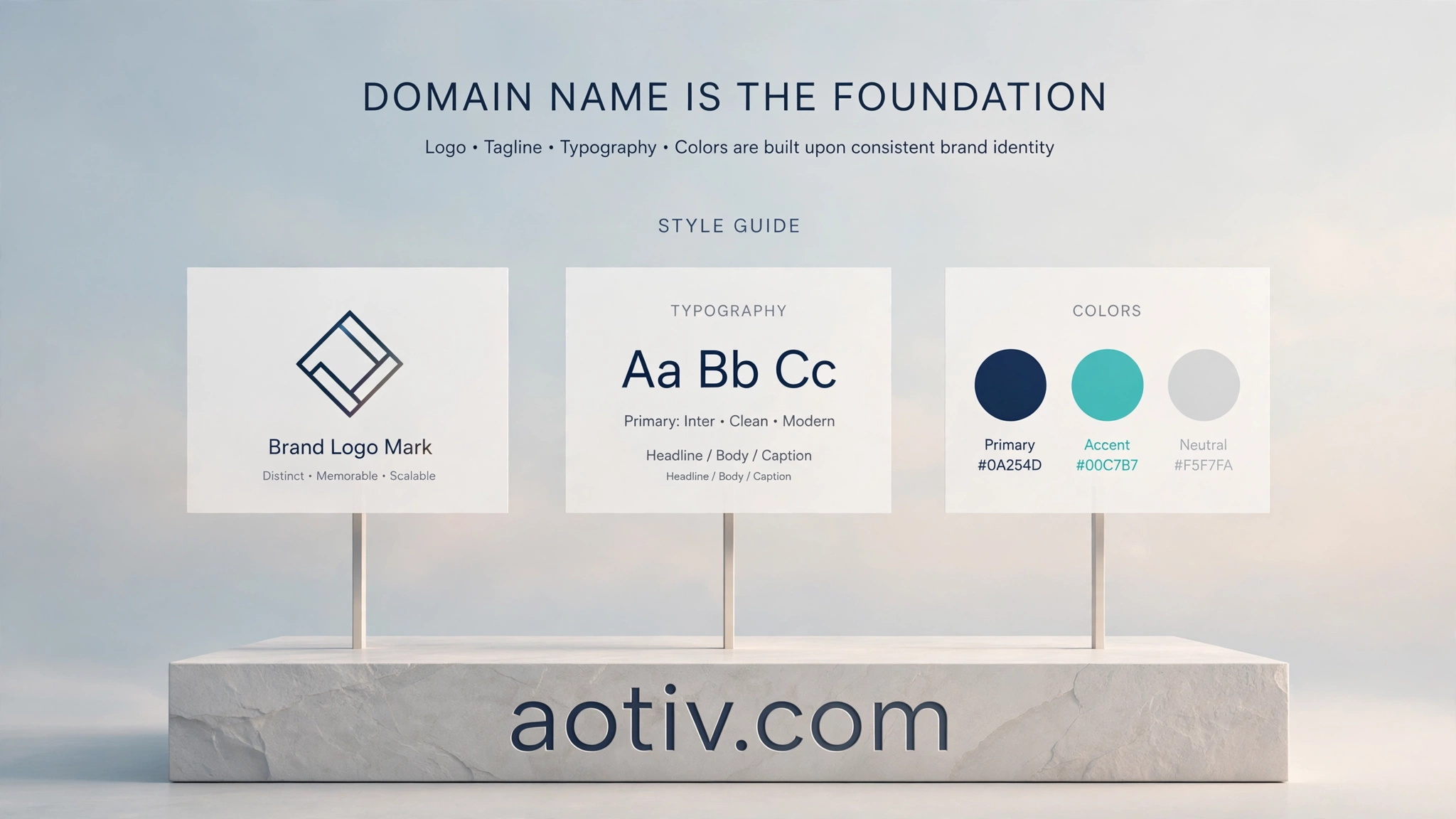
Domain name brand consistency is not a finishing touch applied after the logo, the tagline, and the style guide are already locked in – it is the foundation those assets get built on top of. A domain that matches your business name, your tone, and your visual identity reduces the friction customers experience at every single touchpoint, from a typed search to a spoken referral. A domain that contradicts those elements quietly taxes every marketing dollar spent trying to compensate for it.
If your audit above revealed gaps between your domain and the rest of your brand system, the fix starts with finding a name built to hold that consistency from day one. Browse Aotiv’s curated brandable domain marketplace to find a name your entire brand system can finally be built around.